|
By: Paul S Cilwa |
Posted: 9/11/2026 |
|
Page Views: 120 |
| Hashtags: #Music #Classical #Xylophone #Concerto |
| Four works for xylophone and orchestra, presented with rather more ceremony than the instrument is accustomed to. |
The Shostakovich was a symphony, and it came as three twelve-inch discs in a
bound paper album you turned like the pages of a book. The cover was a painting
of a man at a piano with the Soviet flag flying above him—Shostakovich
himself, I always assumed. My mother took one look at that flag and worried,
aloud and more than once, that listening to it would turn me into a Communist.
(Which, according to J.D. Vance, it did.) I have written elsewhere about
where those
records came from, and what I did to some of them.
What I never had was the means to write the music I kept hearing. Composing is
not one skill but a dozen, and the last of them is the sheer clerical grind:
Tchaikovsky wrote every note of his own orchestration and still needed copyists
to turn a score into parts that sixty players could read from. What has changed,
abruptly and within my lifetime, is that I can now ask for a piece and be handed
one. It is not quite composing and it is not quite not composing. It is closer
to being Tchaikovsky with a roomful of gifted amanuenses instead of one or
two—amanuenses who, awkwardly, can also play.
These concertos are what came of that. The note below is written in the manner
of the record-sleeve essays I grew up reading, and should be believed to roughly
the same degree.
Of all the instruments admitted to the modern orchestra, none has been
so persistently underestimated as the xylophone. Confined for the better part of
two centuries to the depiction of skeletons, comic mishap, and the occasional
startled bird, it has waited with great patience for a composer prepared to take
it at its word. In Paul S Cilwa it has found one.
Cilwa came to composition by an indirect route, having first been a radio
announcer, a truck driver, a lifeguard, and a programmer of some distinction—
occupations which, he has observed, differ less from one another than the casual
listener might suppose, each being fundamentally a matter of maintaining tempo
while somebody watches. It was during his tenure at the wheel of a tractor-trailer,
on the long descent into Flagstaff, that the opening figure of the First Concerto
is said to have arrived unbidden. He was obliged to hum it for four hundred miles.
The manuscripts gathered here come to us from sources of uneven respectability. The
Concerto No. 1 survives complete, though the autograph bears on the second
page of its Fugue a distinct ring left by a coffee cup—a mark which the
eminent Cilwa scholar Dr. Hyacinth Trevelyan-Boake has argued at considerable
length is not a stain at all but a fermata of unusual generosity. Her reading has
not been universally accepted. It has been adopted here.
The Concerto No. 2 arrived, if the composer is to be believed, all at
once, and survives as six numbered sheets bearing no titles, no tempo markings,
and no indication of where one movement is meant to end. It is presented here in
the order the numbering suggests, that being the only suggestion anybody has made
in writing.
The two shorter works are of more contested provenance. Reflective Path was
discovered folded into a service manual for a 1974 Oldsmobile, and
Renaissance Flaire exists in three simultaneous versions, none of which the
composer will identify as the original, and all of which are presented below on the
reasonable grounds that one of them must be.
These performances were recorded over four sessions in a hall selected for the
warmth of its acoustic and the adequacy of its parking. The xylophone is a modern
instrument with rosewood bars, played throughout by a soloist whose name has been
withheld at the soloist's insistence.
You can listen to the whole album here, or visit each work listed below to read
about it and hear its movements individually.
Now Playing:
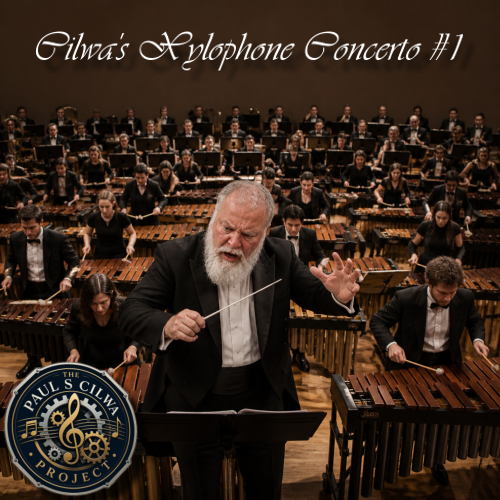
Xylophone Concerto #1
|
By: Paul S Cilwa |
Posted: 9/11/2026 |
|
Page Views: 118 |
| Hashtags: #Music #Classical #Xylophone #Concerto |
| Four movements, one coffee ring, and a tempo marking that may not be one. |
| Estimated reading time: 2 minute(s) (400 words) |

The Concerto No. 1 is cast in four movements and lasts a little
under half an hour, which its composer has described as "about a tank of gas."
It is the only one of the four works presented here whose manuscript is complete,
legible, and unambiguously in his own hand, a distinction he regards as
overrated.
Reflective Path
|
By: Paul S Cilwa |
Posted: 9/11/2026 |
|
Page Views: 92 |
| Hashtags: #Music #Classical #Xylophone |
| Recovered from the glovebox of a 1974 Oldsmobile, and presented twice. |
| Estimated reading time: 2 minute(s) (239 words) |
Of the four works in this collection, Reflective Path has the
least secure provenance and by some distance the most devoted following. It was
found folded into the service manual of a 1974 Oldsmobile Delta 88, between the
section on wheel bearings and the section on the heater core, in handwriting the
composer has described as "probably mine."
Renaissance Flaire
|
By: Paul S Cilwa |
Posted: 9/11/2026 |
|
Page Views: 77 |
| Hashtags: #Music #Classical #Xylophone |
| Three simultaneous versions, no original, and a title nobody has dared correct. |
| Estimated reading time: 2 minute(s) (353 words) |
The textual situation of Renaissance Flaire is without parallel
in the composer's output. It exists in three complete versions, none of which can
be shown to precede the others, and all of which the composer maintains he wrote
first. Editors have generally responded to this by printing all three and declining
to discuss it.
Xylophone Concerto #2
|
By: Paul S Cilwa |
Posted: 9/19/2026 |
|
Page Views: 102 |
| Hashtags: #Music #Classical #Xylophone #Concerto |
| Six movements, no titles, and a manuscript numbered on the wrong side. |
| Estimated reading time: 3 minute(s) (508 words) |
A concerto in six movements is not, strictly speaking, a
concerto. It is a concerto that declined to stop. Cilwa has been pressed on the
point more than once and has answered each time that he counted them the same
way anybody else would have, and that six is simply what there were.