|
By: Paul S Cilwa |
Posted: 6/5/2010 |
|
Page Views: 1,306 |
| Hashtags: #Biosphere2 #Arizona |
| Zach and I visit Biosphere 2, the world's largest greenhouse, with some friends. |
| Estimated reading time: 6 minute(s) (1368 words) |
In my original post about Biosphere 2,
I gave a pretty complete run-down of the
place and its history; so I won't bother repeating that here. Instead, we'll
just take a quick look at the changes since our last visit.
In addition to Peter, myself, and Zachary, we had with us two
sons and a nephew of Peter's wife's friend, visiting from Germany.
They are: Sylvan, 16 (nephew), and Eric (12) and Linus (13). (I
apologize if I've misspelled their names.)
The fastest way to the Oracle area from my neighborhood (and
Peter's) is to take US 60 a few miles west, then AZ 79 south through
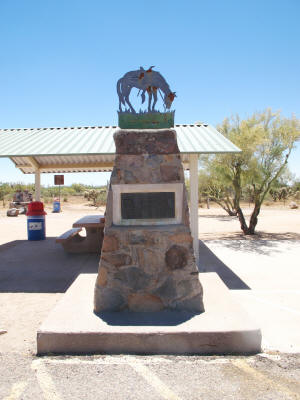
Florence. Just south of the town is a monument to a silent movie
star, Tom Mix, one of the
first movie cowboys, who died at this spot.
According to Wikipedia:
On the afternoon of October 12, 1940, Mix was driving his 1937 Cord 812
Phaeton near Florence, Arizona, (between Tucson and Phoenix) on Arizona
State Route 79 when he came upon construction barriers at a bridge
previously washed away by a flash flood. A work crew watched as he was
unable to brake in time and his car slid into a gully. A large polished
aluminum suitcase he had put on the seat behind him flew forward and struck
Mix in the back of the head, shattering his skull and breaking his neck. The
60-year-old actor was killed almost instantly.
Of course, none of the kids with us had ever heard of Tom Mix. Despite his
fame of a century ago, all that's left are a few silent moves (and a couple of
poorly-received "talkies"), and this monument.
After about an hour's drive altogether, we arrived at the Biosphere 2
complex. (Biosphere 1 is Earth.) Peter paid our admissions, and we walked
through the village where visiting scholars stay, to the steps leading down to
the structure entrance.
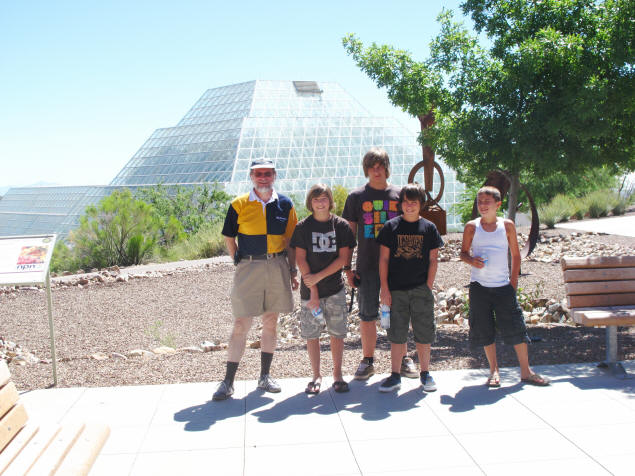
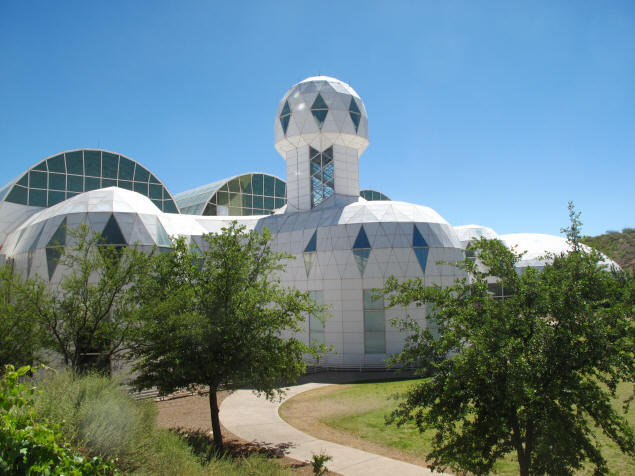
Biosphere 2 itself, as one approaches, almost looks like
Cinderella's castle or the Emerald City.
Our tour wasn't to start until 3 PM, so we took a little time to visit
the exhibits that now occupy the spaces once used by the human
residents of the Biosphere 2, known as "Biospherians", to perform
experiments during the years they were locked inside.
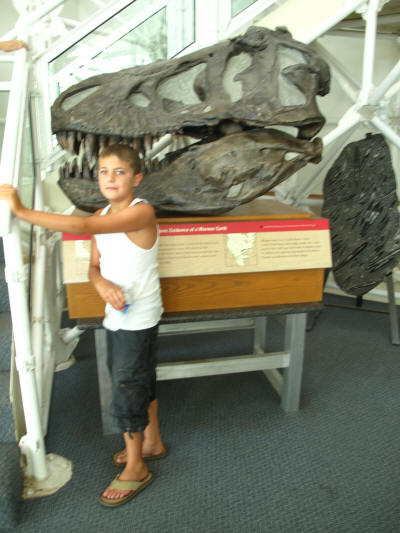
Among the exhibits was a cast of a T-Rex fossil that had been
found in the area. That, of course, excited the boys, who gathered
around to inspect it.
This area also gave us a look at the first big change since
Zach's and my last visit in 2007. A large area had been devoted to
agriculture, growing the food the Biospherians were to eat while
locked inside, since the whole idea was that nothing whatsoever, not
even gases, were to come in or go out once the door was locked.
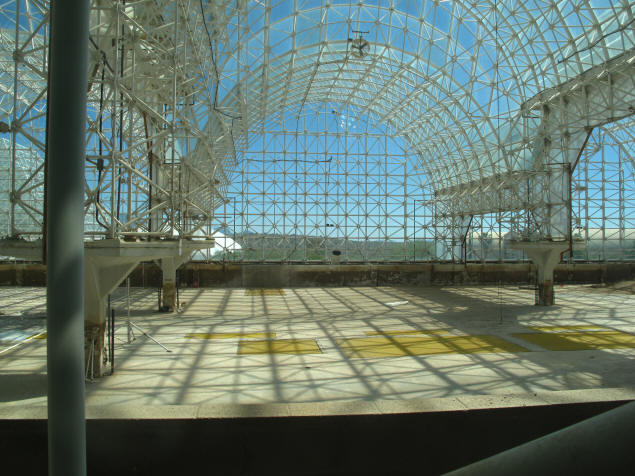
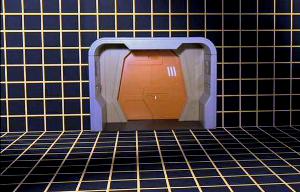 But
those experiments have ended. So the agricultural section has been
completely cleared to make way for a new experiment that will study
the effect water has on shaping geologic processes. But for now, the
empty area is impressive in its own right, looking almost like a
Star Trek Holodeck in between programs. (And, in a sense, that's
exactly what it is!)
But
those experiments have ended. So the agricultural section has been
completely cleared to make way for a new experiment that will study
the effect water has on shaping geologic processes. But for now, the
empty area is impressive in its own right, looking almost like a
Star Trek Holodeck in between programs. (And, in a sense, that's
exactly what it is!)
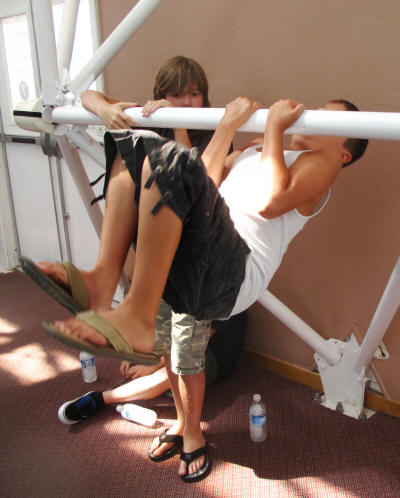
We returned to what was once the communal dining area just before the
tour was to start. All the original Biospherians were adults; what a
shame—the exposed framework of the structure was ideal to entertain
kids during the tour guide's pre-tour spiel.
After delivering a general overview, she opened the airlock and
led us into first habitat zone of Biosphere 2. (There's an airlock
because the most comfortable temperature and humidity for working
humans is not necessarily that of the plants on the other side of
the door.)
In fact, what was on the other side of the door (after a short
walk) was Biosphere 2's ocean. It isn't enormous, but it's
deep and has waves and a beach.
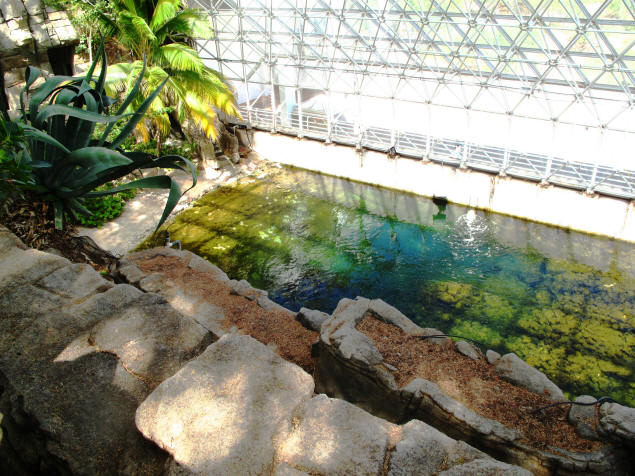
This is out of sequence, but here's a shot of the ocean taken from a
different perspective, from over the beach.
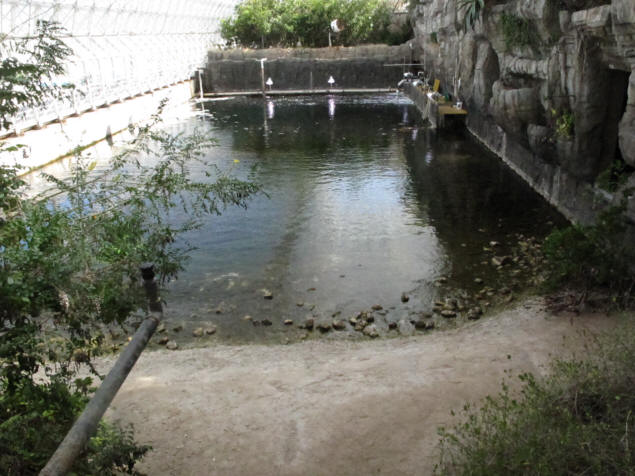
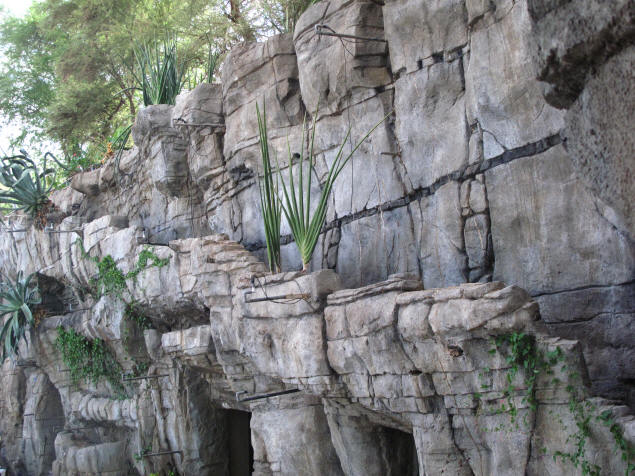
Also, notice the cliff wall: It's actually made of cement very
cleverly designed to resemble natural rock.
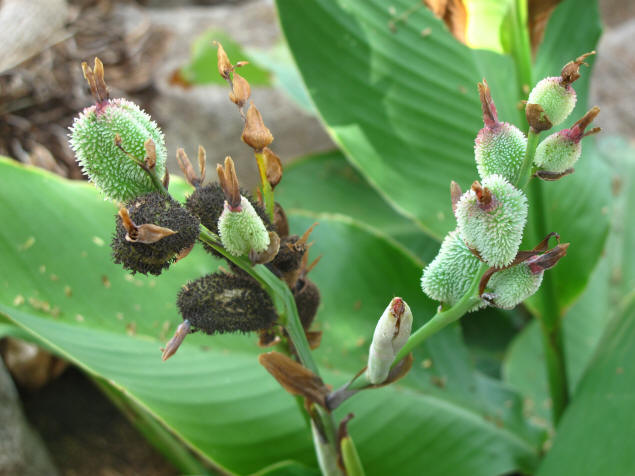
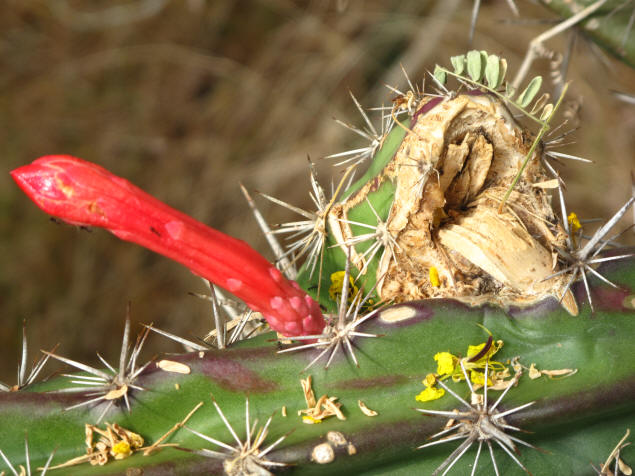
Of course, with my penchant for taking close-up photos of plants and
flowers, I couldn't resist taking a few shots of the greenery that
was so close…even though, as usual, I had no clue what
kind of plants they were.
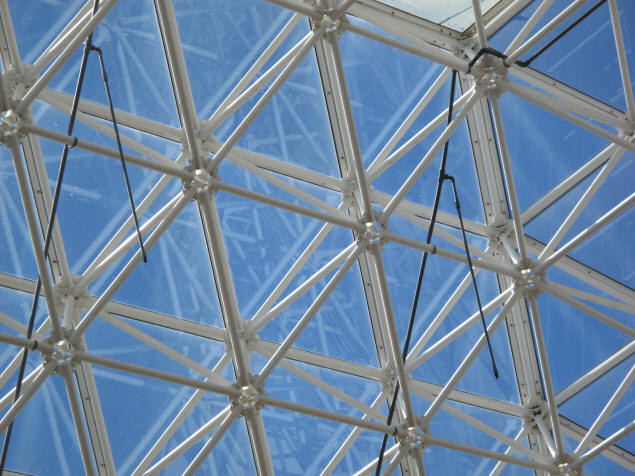
There are a number of different biomes in Biosphere 2, each with its
own temperature and humidity requirements. Among other things, this
means that rain must be created to order. The ceiling of
Biosphere 2 is equipped with special nozzles that make it possible
to do just that.
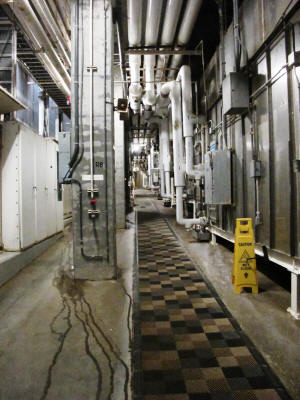
After touring several of these biomes, some of which were in the process
of being reconfigured for new experiments, we all trooped down to
the "basement" to see some of the inner workings that made this
scientific tool possible.
Vast areas were taken up by air conditioners and water pumps. We stopped
several times so our guide could explain what we were looking at.
Considering that English is a second language for our German
visitors, the boys did amazingly well at following the lecture and,
indeed, at keeping politely still during them.
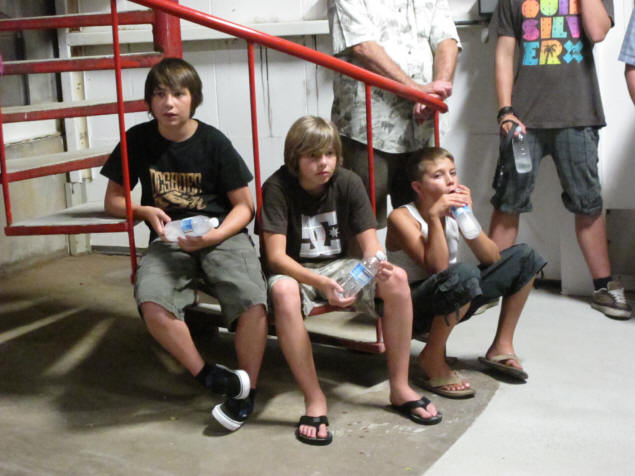
After having been shown various pumps and compressors, we took a
brief shortcut through the rain forest…
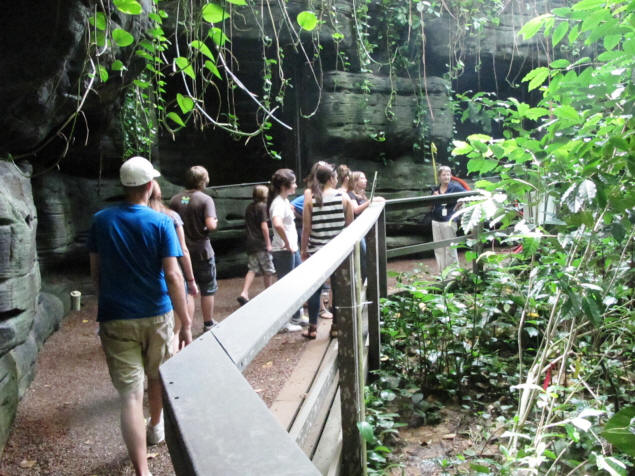
…to a low, 8-foot-long tunnel through which we had to stoop…
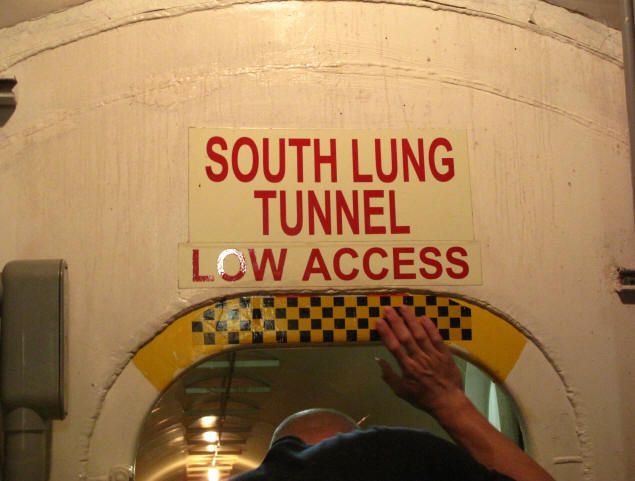
…to get to what is, arguably, the single most impressive yet
understandable piece of technology in the entire complex: The
Biosphere 2's "lung".
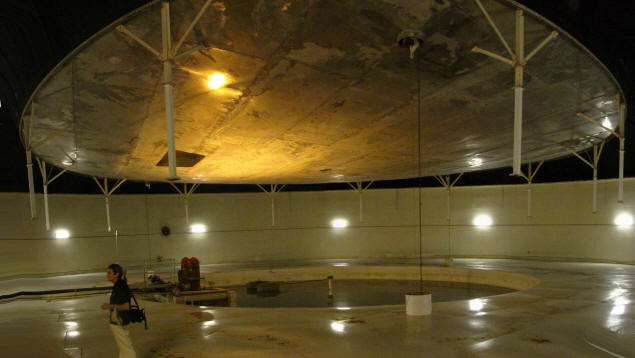
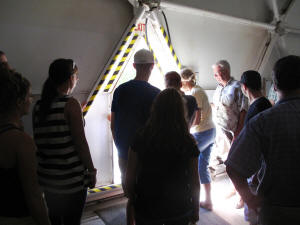
So large it can't meaningfully be squashed into even a panoramic
photo, the lung solves this problem: Biosphere 2 encloses a huge
space, which by intention receives the light and heat of the sun
through hundreds of thousands of panes of glass every day. As it
warms throughout the morning and afternoon, the air inside expands,
as warm air does, creating higher air pressure inside than
out—which, if nothing were done, would blow out those very panes.
So a "lung" was built of a massive, one-piece, rubber gasket and a huge
iron weight combination. As the air expands during the day, it
rushes into the lung where the iron weight rises and the gasket
expands. When it cools in the evening, the air returns to the
greenhouse thanks to gravity's pulling down the iron weight.
After we had adequately marveled over the lung, we stepped
outside the building (almost flying out on the rush of air through
the opened air lock) and got a look at the short, constricted
tunnel from the outside.
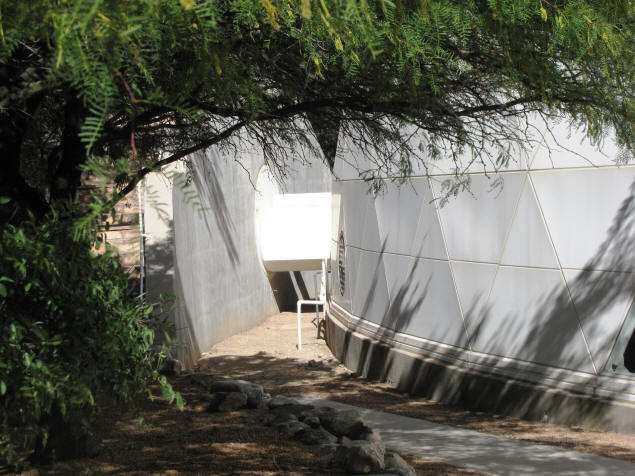
As we walked outside back to where the tour began, I was struck with
the beauty of the grounds and the structure itself. From an
engineering standpoint, there is no doubt that Biosphere 2 is a
marvel and technically beautiful. That it is also aesthetically
beautiful doesn't necessarily follow, but is certainly the case.
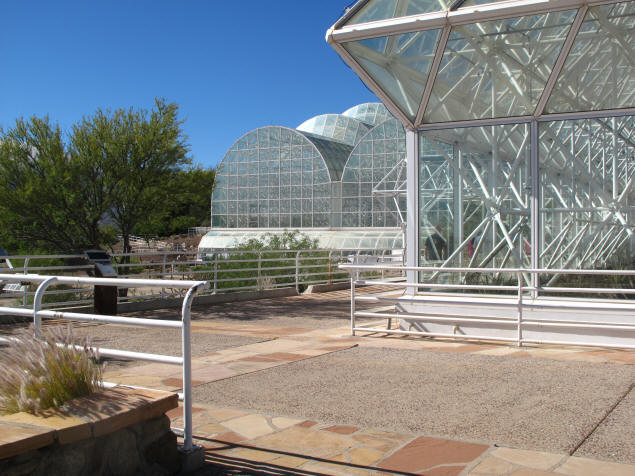
And the landscaping around it contributes, with the color and scent
of flowers decorating every turn.
The tour over, we applauded our guide and made our way back
through the village to the parking lot. The village itself, though,
catching the late afternoon light, also contributed to the general
sense of beauty about the place.
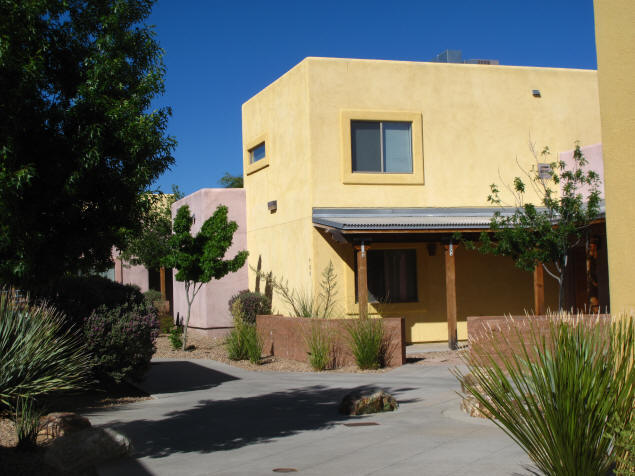
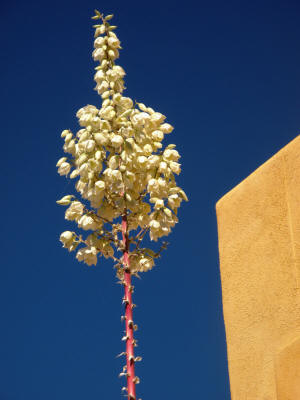
I especially appreciated the stark contrast of colors between the deep
blue sky, the adobe walls, and the blossoms of the yucca plants.
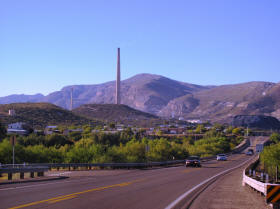
So, after the required restroom visits, we piled in the car and
made it home via a different route that took us through some
mountain passes for the entertainment of the boys, passing
through the town of Kearny and a series of active copper mines, then
the near-ghost town of Superior whose mines have mostly closed. We
got back home shortly after 7 PM, and said goodbye to our new German
friends after another enjoyable day of showing off Arizona.