|
By: Paul S Cilwa |
Posted: 4/26/2010 |
|
Page Views: 1,117 |
| Hashtags: #Kauai #Hawaii #KipuFalls #WailuaRiver |
| Michael and I swim at a waterfall, take a river cruise, and attend a luau! |
| Estimated reading time: 10 minute(s) (2214 words) |
We had three adventures planned for the day. First, a hike to an
off-the-road waterfall we could swim at; second, a river tour by
boat; and three, a full-out Hawaiian luau.
The swimming adventure was to take place at Kipu Falls, which I
found on the web, along with directions. The GPS did not know where
the falls are (no surprise, since it's non-commercial and off the
road) and, while I could have put in coordinates, I
didn't have them, since Google Earth hasn't been installed on this
netbook. But, no matter. The directions included a road intersection
and that was something the GPS understood.
We drove off the main road, and then onto a lesser road, and
finally a minor road that, though paved, was too narrow in most
places for two vehicles to pass. We came to a place where four or
five cars were parked in the reeds at the side of the road, and I
rolled down the window to talk with a guy loading things into his
trunk.
"Is Kipu Falls anywhere near here?" I asked.
"You've found it!" he assured me with a friendly smile. "Park
anywhere. It's that path over there."
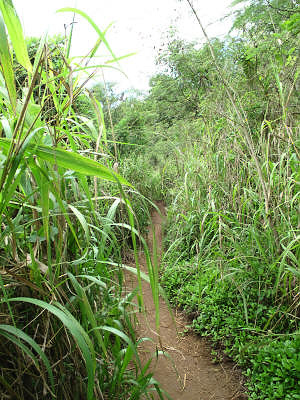
"That path" was an unmistakable break in the thick, Hawaiian
grasses. Michael and I got our gear together (towels, water,
sandals, cameras—we were already wearing our bathing suits) and
headed down the path.
At once we were enveloped by the thick, jungle smells: musky,
fragrant, delightful. We couldn't see much from the trail, though
here and there a partial clearing would afford a view of the river
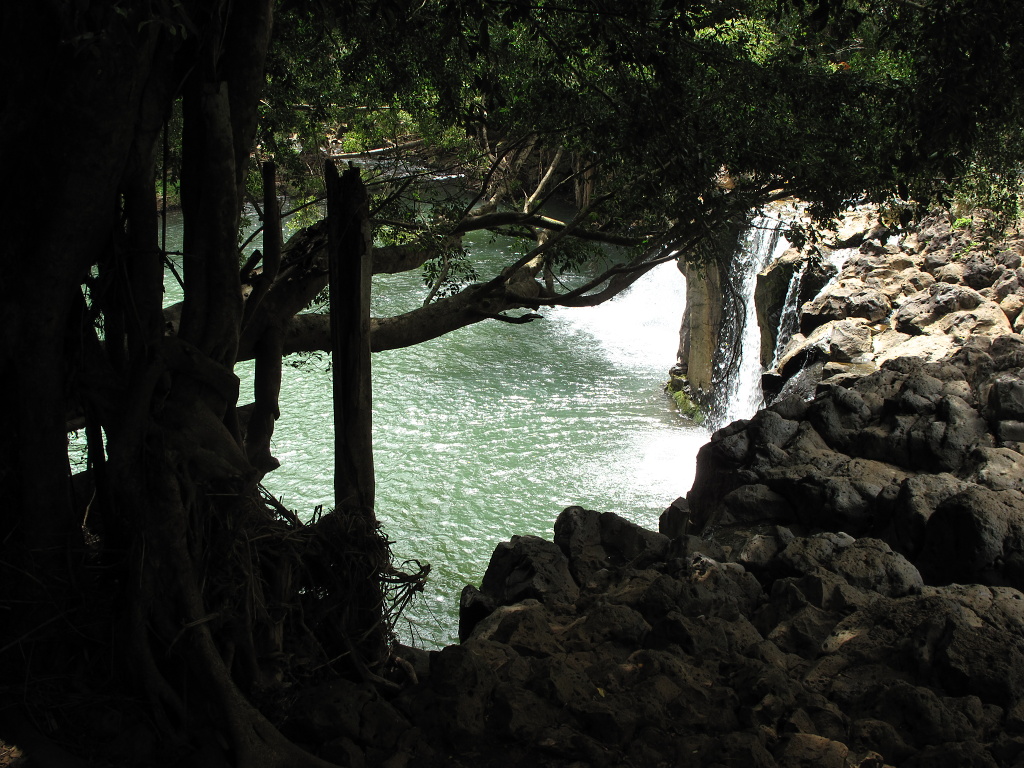
below. The path gradually descended until we were at the river
level, about the same time that a roar was added to the soughing of
the wind through the trees. There it was: Kipu Falls.
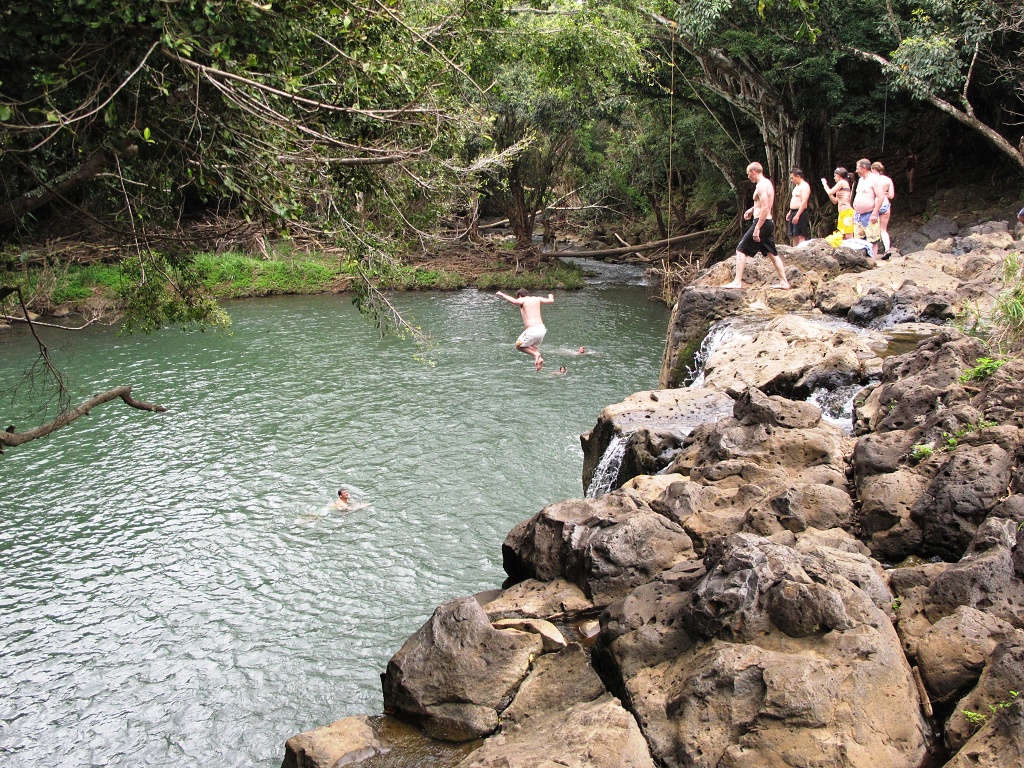
The other people here comprised maybe four or five small groups,
mostly families; but they were spread out so the place didn't seem
crowded. The only bad part was, Michael and I couldn't find a way to
the base of the falls, where we wanted to swim, without jumping.
There was a ladder, but everyone else was using it to climb back up
after either jumping off the edge or swinging on a rope into the
water.
I'd been told specifically by a local friend not to jump off the
rocks. "Every week," he said, "at least one person winds up in the
emergency room from hurting themselves at Kipu Falls." But he hadn't
said anything about the rope.
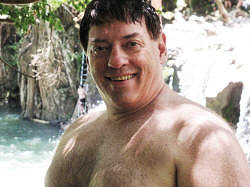
The rope had clearly been there a long time, and everyone was using it.
The ladder we had seen was bolted to the rocks, so the whole thing
had clearly been thought out.
Michael was willing to take the ladder down to the pool,
and I told him there was no reason why he shouldn't. But he's 60.
I'm only 59, and I figured I was still good for a swing on the rope.
The dad of some of the kids who'd been using the rope pulled it
in for me and handed it over. It was thick, like a gym rope, with
thick knots to assist in holding on. I wrapped my fists above two of
the knots and realized I couldn't back out now.
"Oh, fuck." I blurted out loud, and pushed off from the rocks.
As I swung over the water, I felt and heard a pop!
come from my right elbow. My arm instantly burned like fire, but I
held on until I'd reached the apex of the swing, then let go,
dropping into the water like a bag of wet cement. It was deep and
cool, but my right arm wouldn't work right. I couldn't use it to
swim. If I let it relax, it didn't hurt; but when I tried to extend
it, it hurt badly and I tried not to do that for fear of damaging
myself further.
Fortunately I'm comfortable enough in the water to not panic. I
can swim with one arm. I could swim with no arms if I had to.
The fact that my body fat ratio allows me to bob like a cork helps.
Michael could tell something was wrong and I called that I had "kind
of maybe" dislocated my elbow. I had to side-stroke back to the
ladder. By now, Michael had come down and, once he knew I wasn't in
constant pain, we decided to go ahead and float in the deep pool for
awhile before returning to the top of the falls.
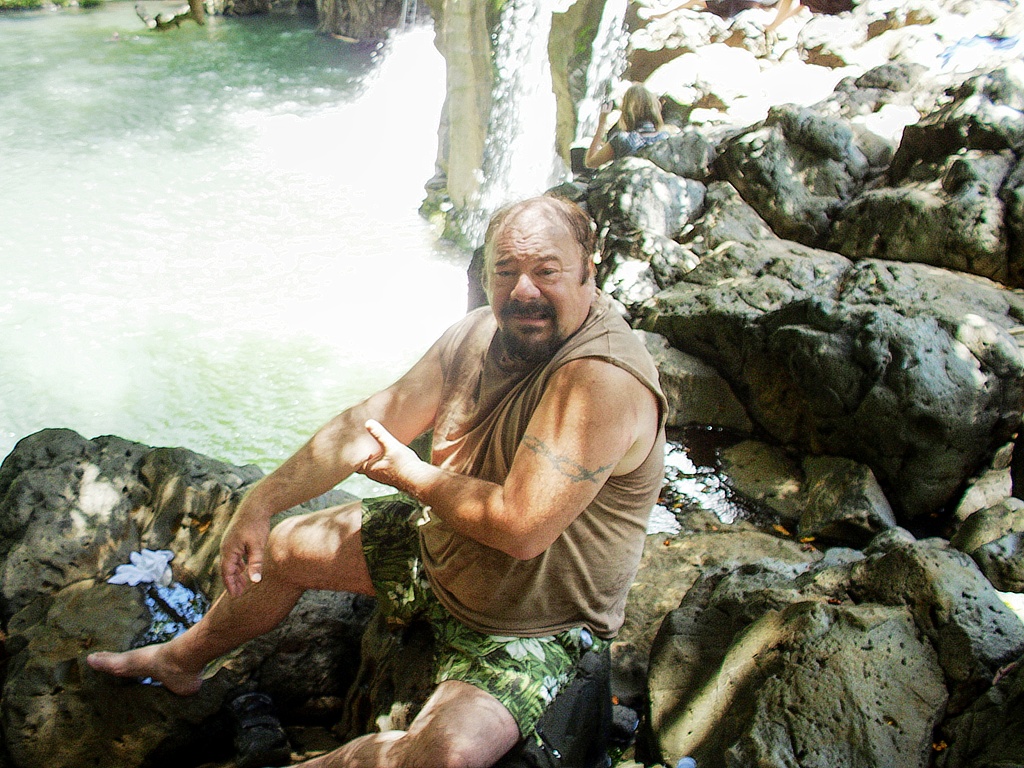
The hard part turned out to be getting out of the water to get
to the base of the ladder. There were no footholds and with only
one working arm, I had the devil's own time trying to land
myself. It didn't help that Michael kept drawing parallels to the beached
sea lions we'd seen yesterday. He wanted to help, but I couldn't
risk his pulling my bad arm and I needed the good one to try and
lift myself. It literally took 30 minutes before I was in position
to climb the 30-foot ladder to the top of the falls.
And, of course, climbing a 30-foot ladder with one dead arm is a
challenge in itself.
But, as I said, I'd do it all again. The falls were breathtaking;
the water was delightful and the injury (from the viewpoint of hours
later) seems to be minor.
Though obviously I need to lose some weight. Or work out more. Or
something.
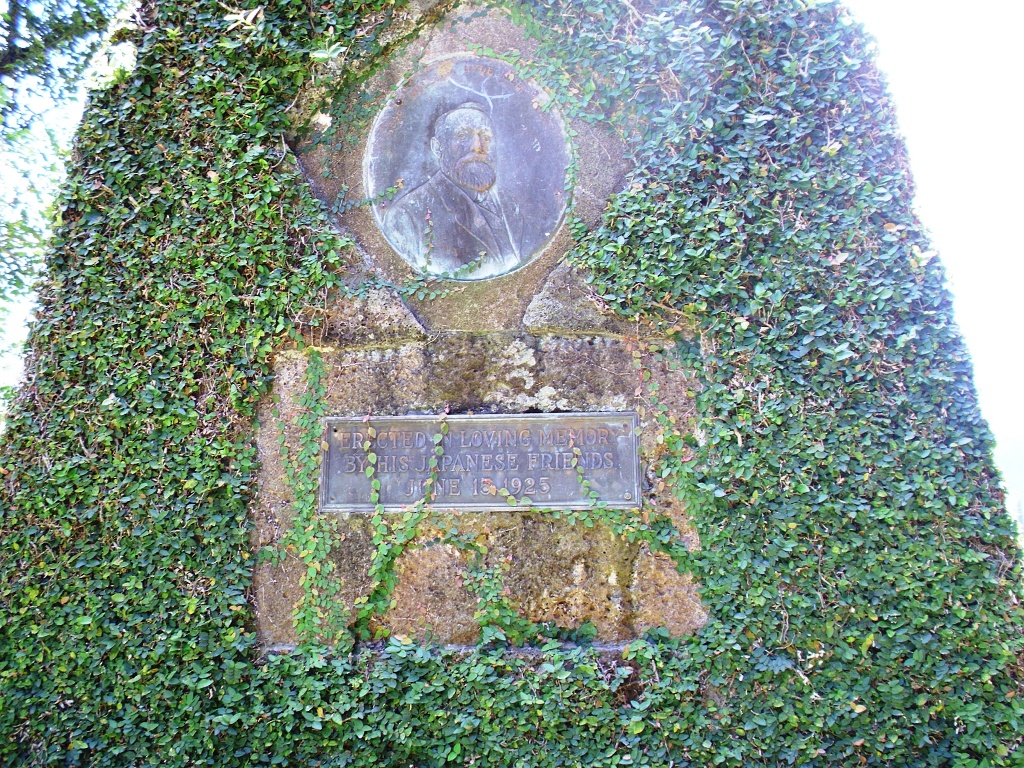
Back in the car, which I now had to drive one-armed, I decided to travel
a little further along the road to find a place wide enough to turn
around. That turned out to be a turn off for a very old monument,
made of stone but completely covered with vines, dedicated, it turned out, to one
William Hyde Rice,
by his "Japanese friends."
We figured Rice must have been a governor of Hawaii, or maybe a
diplomat assigned to Japan. But when I looked Rice up, it turned out
he was a businessman and politician who lived here during the
fall of the Kingdom of Hawaii.
That was the period when the American owners of the pineapple and sugarcane plantations got tired
of sharing their profits with Queen Lili'uokalani and cut her out of
the deal by convincing the United States to step in and take over
"for the good of the Hawaiian people."
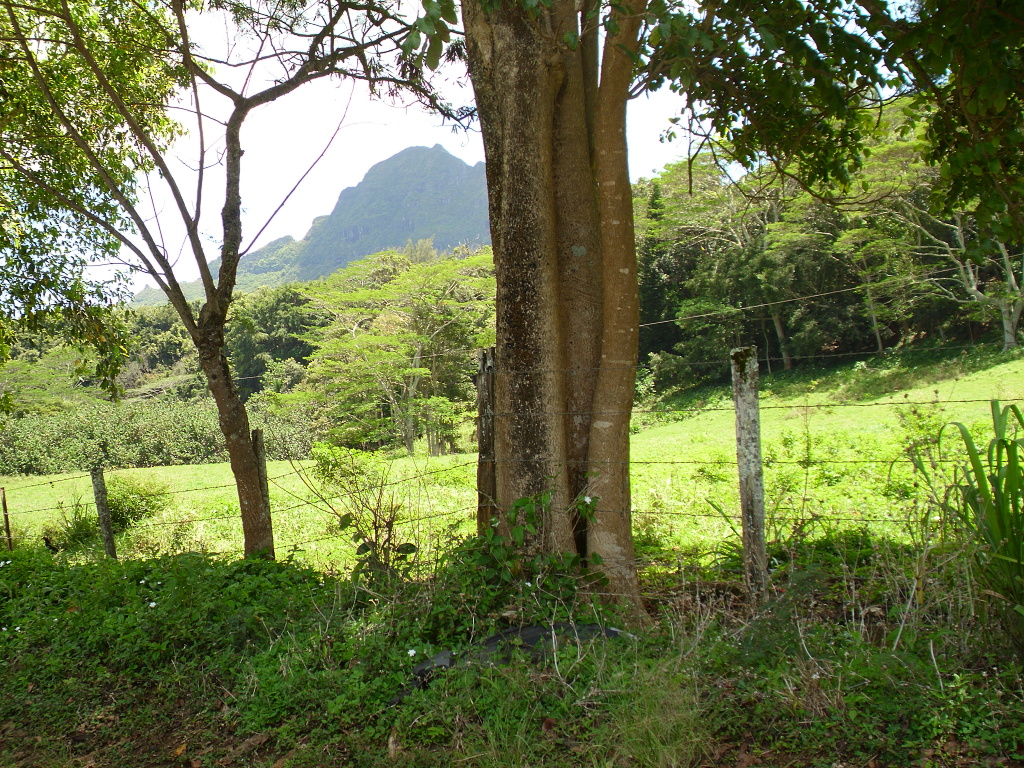
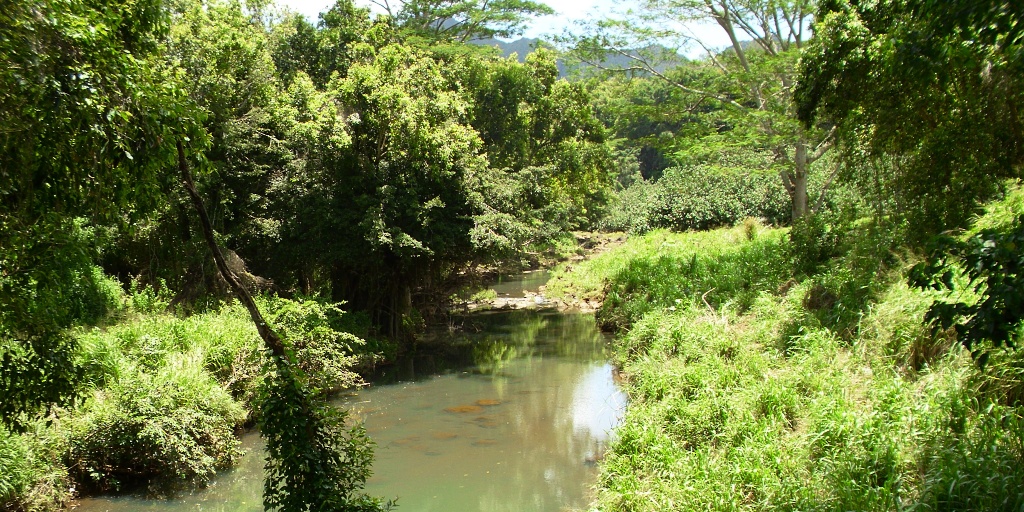
As we returned to the main road, we were again struck by the
natural and pastoral beauty of this land.
We returned home to change clothes, and Michael loaned me his
magnetite bracelet to wear on the theory that it might help my arm
heal faster. My arm didn't bother me anyway, as long as I let it
rest.
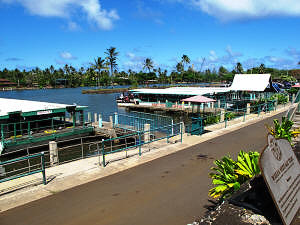
We drove up past Lihue to the Wailua State Park and home of
Smith's Tropical Plantation,
to catch a tour boat from the marina. Almost all the boats there belonged to
Smith's.
Presently it was time for our tour to leave. I knew it was
supposed to last an hour and a half, but I assumed that would all be
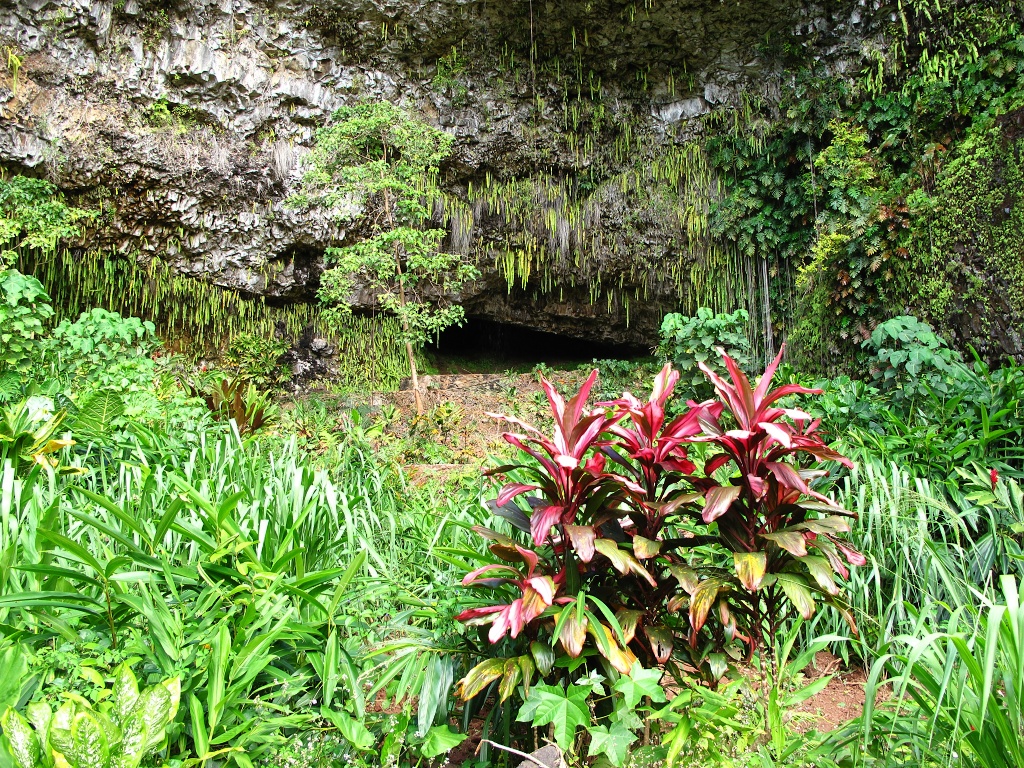
spent in the boat. As it turned out, we were heading for Fern
Grotto, a short 18 minute trip, and would be strolling to the grotto
and touring the area on foot for 40 minutes.
Now, if I'd known that was the case, I might not have
signed up for the river tour. But there was live music on board, and
hula dancing, and the captain gave a very funny (but accurate) spiel
describing the geography and history of the area. So it really
was all worthwhile.
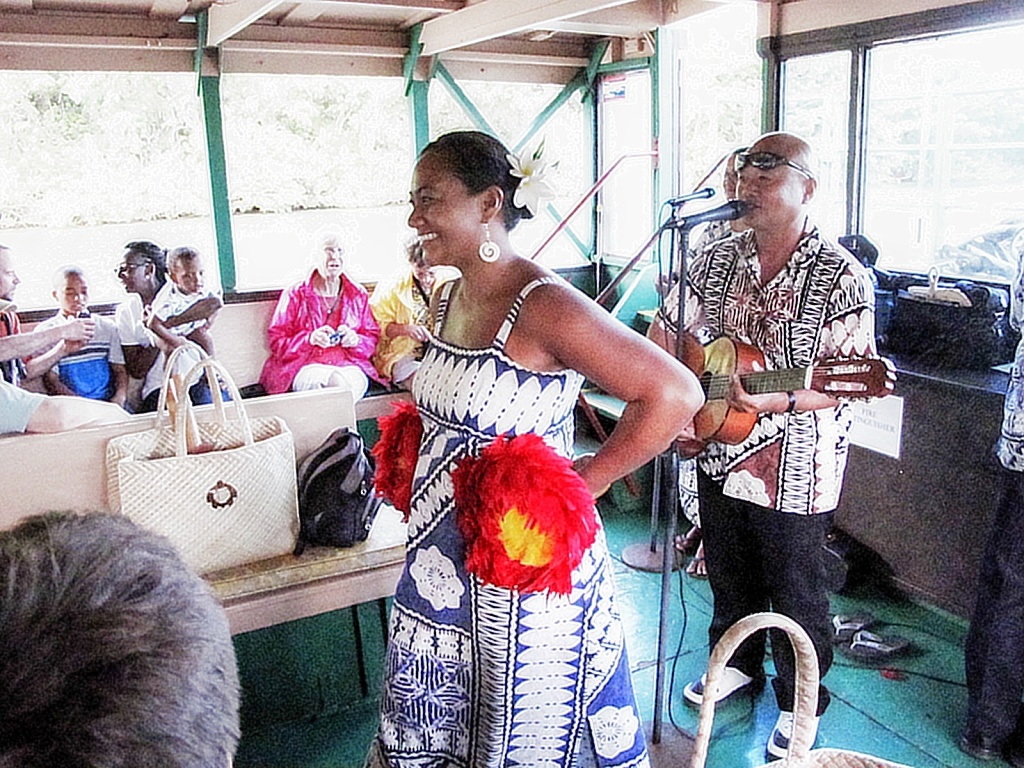
The captain pointed out the field over which "Incans" chased Indiana
Jones in Raiders of the Lost Ark. And the guy singing on the boat had
been in any number of movies, and his guitarist had been a
semi-regular on Hawaii Five-0.
The Fern Grotto itself, we were told, was once a sacred spot to the
ancient Hawaiians who worshipped Lono, their goddess of agriculture
and peace, there. When the Christian missionaries showed up, they
forbade anyone's going to the Grotto under pain of death. So the
place was forgotten until 1946, when "Grandpa and Grandma Smith"
went canoeing along the river. When they discovered the beautiful
grotto, it occurred to Grandpa Smith that a whole tourist empire
could be built around it. Or something.
There's no denying, the Fern Grotto is a beautiful spot.
When we returned to the marina, we walked a few hundred feet to the
entrance of Smith's Tropical Paradise, which is an extensive garden
and location of a grand luau or traditional Hawaiian feast. As we
entered, a photographer took our picture with a couple of hula
persons which made me worry that this was one of those places that
nickels and dimes you for "souvenirs". However, this was the only
one. (And I did buy the photo.)
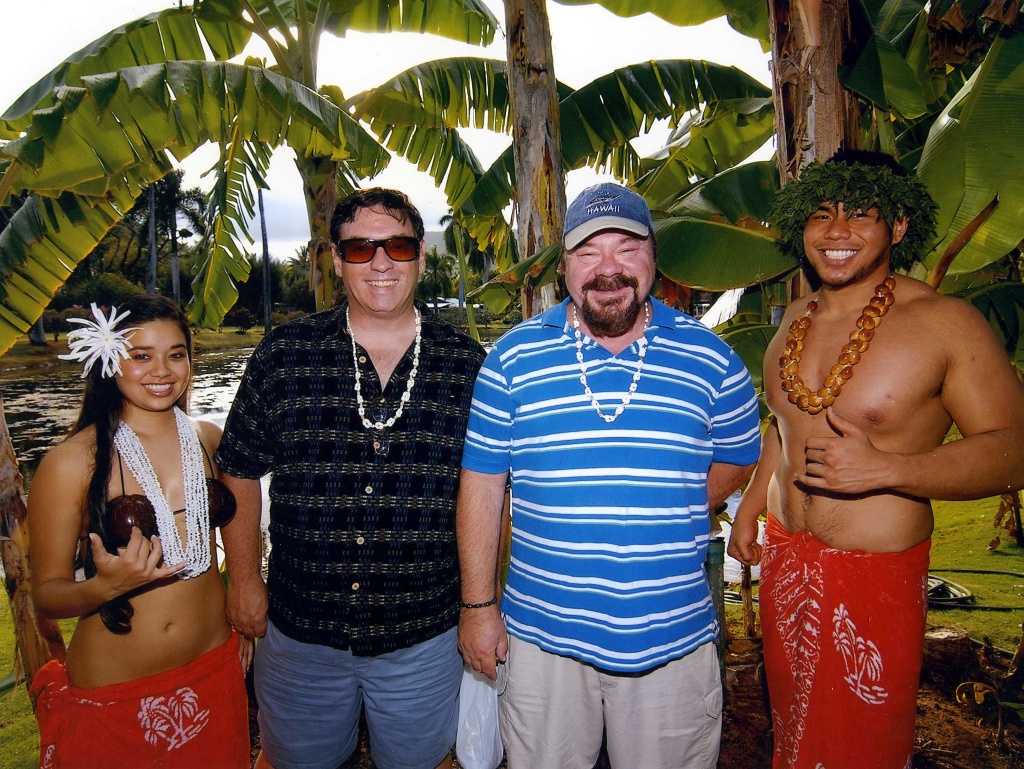
By the way, that's not a backdrop we were photographed
against…it's the real place.
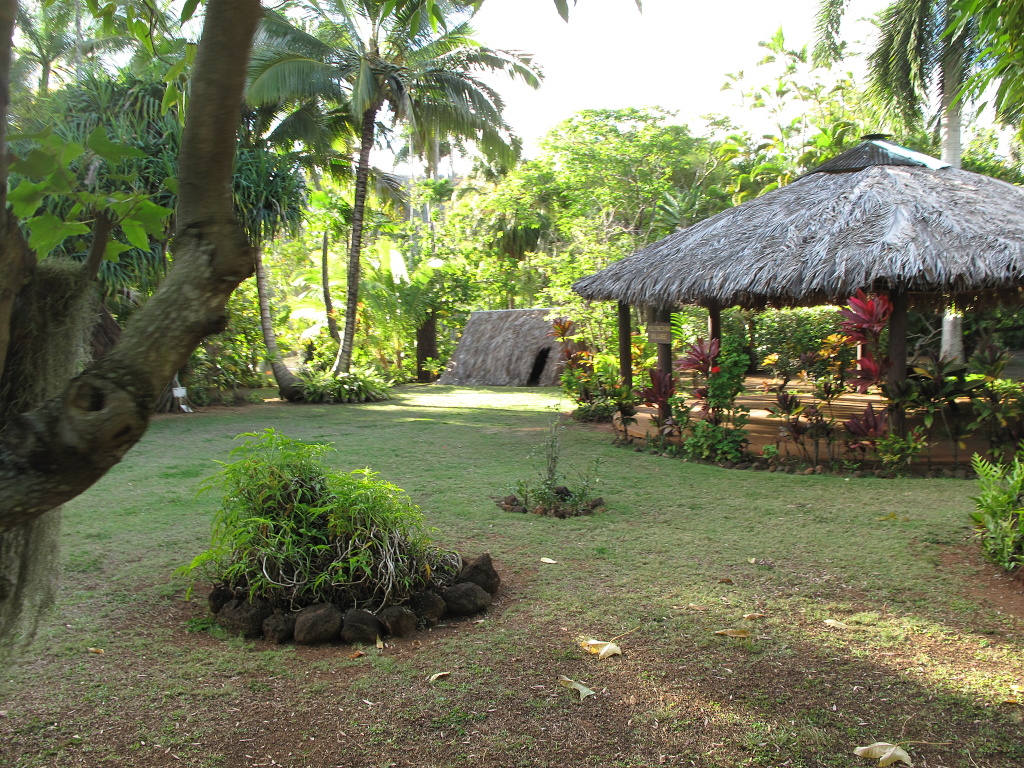
While waiting for the luau to start, Michael and I toured the
grounds. There was every conceivable kind of flower, and even
mockups of ancient Polynesian villages.
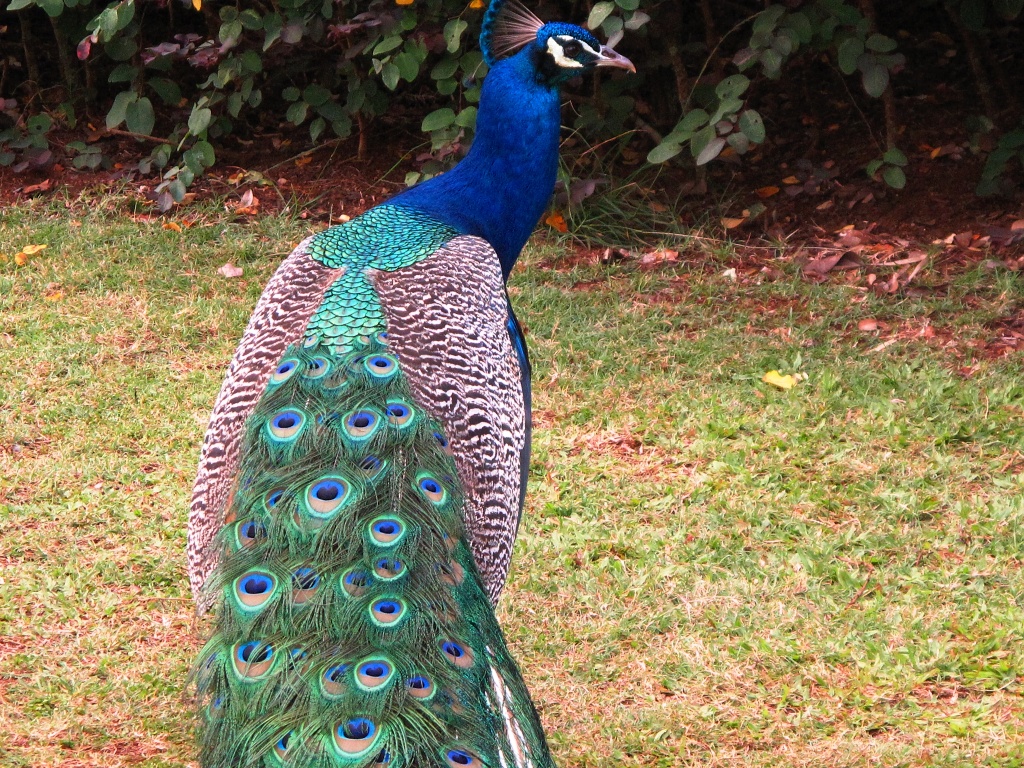
There was also a sizable peacock community which was competing with
the ever-present chickens (which, we were told, are simply picked up
and cooked by anyone who's a little peckish for chicken).
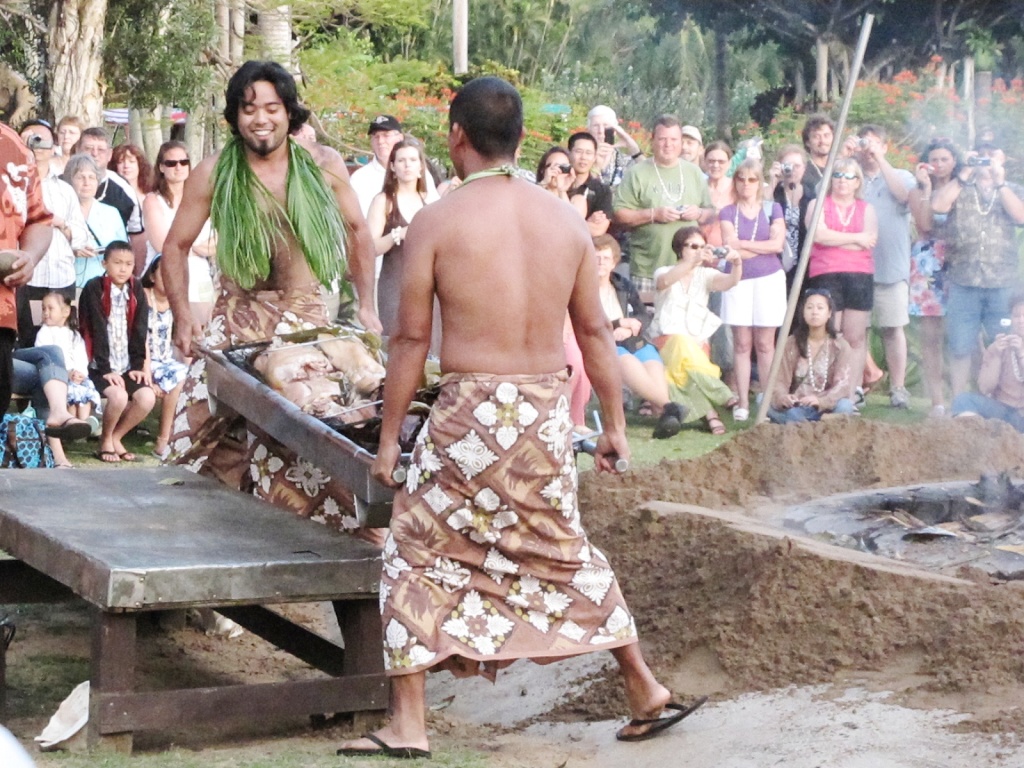
They then had the "Imu Ceremony". An imu is an underground fire pit,
or, as our host put it, "A Hawaiian microwave". A Kalua pig had been
roasting there for eight hours and was now done. The two masters of
the Imu Ceremony blew shell horns in each cardinal direction, then
dug up the pig (which was wrapped in palm fronds) and brought it to
the surface.
We then gathered for the feast. I have no idea how many people were
being served in the covered, open-air pavilion, but it was certainly
in the hundreds. There were three buffet tables, and three
open bars, one serving Mai Tais (a drink made with rum and tropical
juices), one with Hawaiian Punch and water, and a regular bar for
sodas, beer and wine, all covered by the entrance fee.
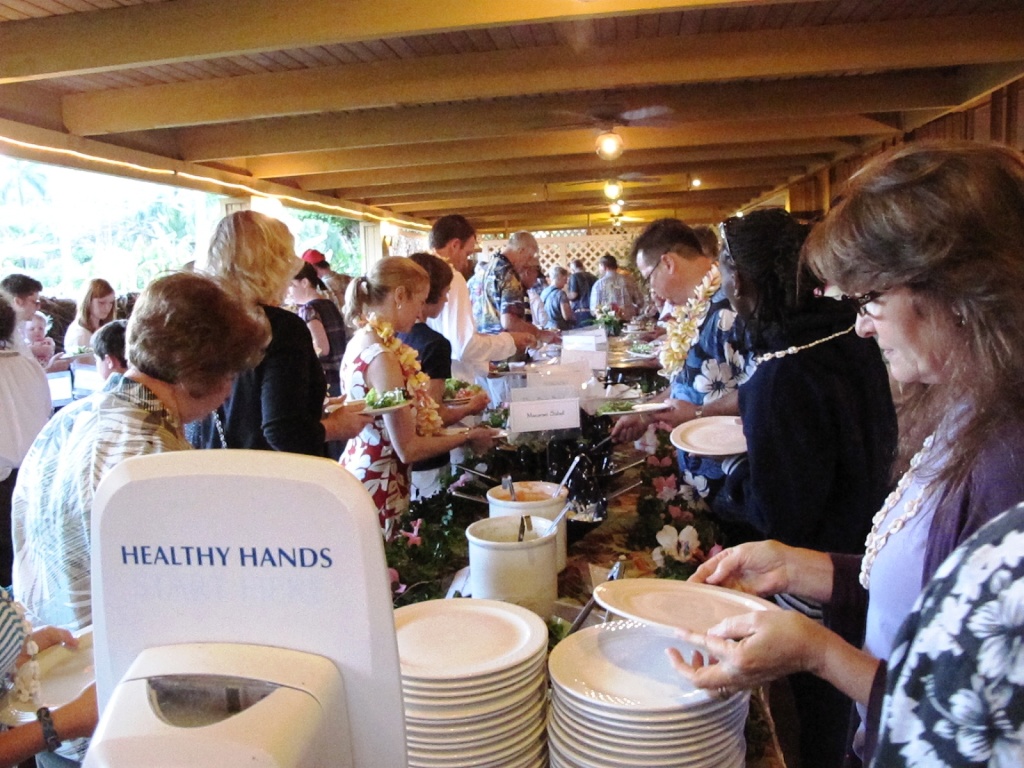
I had salad with papaya dressing, a little macaroni salad, teriyaki
beef, Hawaiian sweet potato (it was purple!), fried rice, and of
course, the pulled Kalua pig, which had a very distinct but
delicious flavor. For dessert there were tropical fruits and coconut
milk cake.
And, of course, there was poi. Poi is a traditional staple food
of the Hawaiians, sort of like Hawaiian grits. After going on about
how much Hawaiians "love their poi!", our host allowed as to how it
was a bit bland and takes some adjusting to. He said if we didn't
like it plain, we should try adding a pinch of salt. And if we still
didn't like it, we should try it again after four or five Mai Tais!
I added the salt and had two Mai Tais, and I finished all of
mine. It wasn't bad. Apparently, pretty much anything tastes better
with enough Mai Tais.
But I probably won't be buying any from Sprouts when I get home.
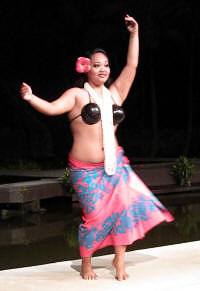
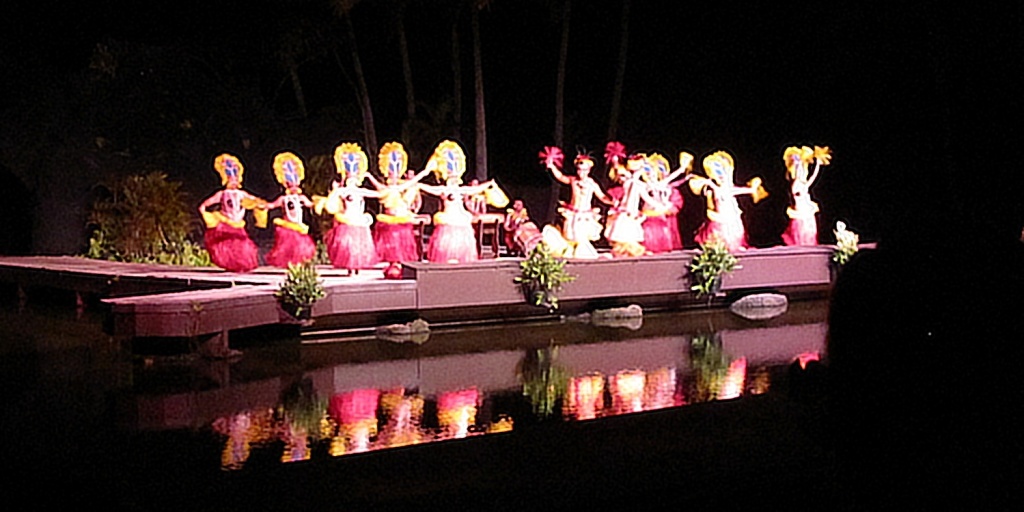
After dinner, we were treated to a show in an amphitheatre that
included a fake volcano, and a couple dozen dancers who were
startlingly talented. They were also surprisingly familiar: one had
sold us our tickets; another had posed for pictures with us when we
came in. But the music was awesome, the effects definitely
impressive, and the whole absolutely worth the time spent to see it.
The theme of the show was "The Golden Peoples of Hawaii" and
showcased each of the Polynesian groups that contributed to the
settling of Hawaii: The Tahitians, Samoans, Maori, Philippines, and
the Japanese and Chinese (the latter two brought in as slave labor
to work the pineapple and sugar cane fields).
The narrator explained that, in the ancient, male-dominated Hawaiian
society, only men danced the hula…women, in fact, were
forbidden to dance. The hula was also performed naked (as were
most island activities, in this land of perfect year-round
temperatures). When the missionaries showed up, they were
horrified at the "heathen" dancing and forbade the men from doing it
anymore. So the women began to do it, secretly at first, so that the
culture wouldn't be lost forever.
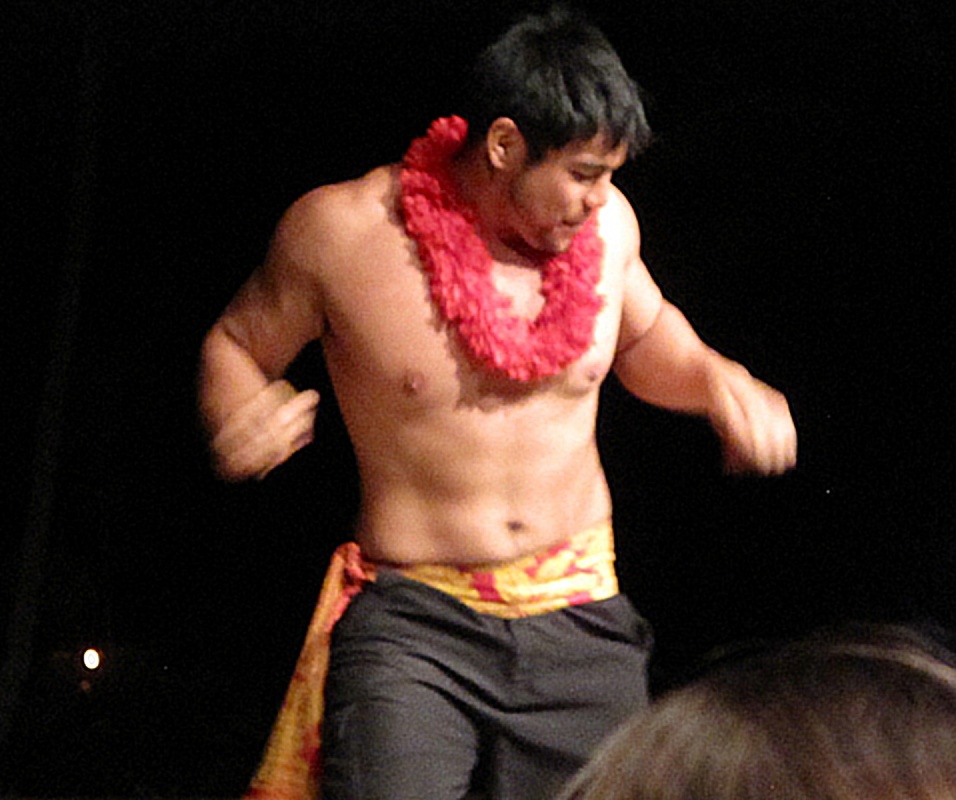
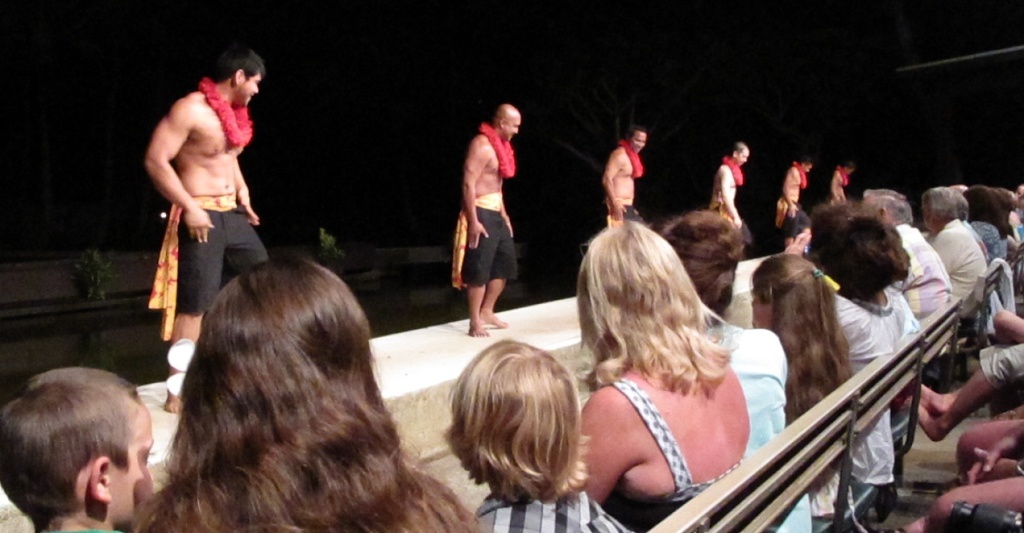
Now, of course, the men can dance once again, and did in the
show. Sadly, they didn't do it naked.
The show ended about 9:15 pm and we waddled to our car, stuffed and
happy. On the way home we found a Wal-Mart and of course had to stop
there—Michael never misses a chance to visit a foreign
Wal-Mart.
We were exhausted by the time we got back, but put in a movie
anyway, a gay romantic comedy called I Think I Do. My eyes
kept closing during it, so I'm not sure if it was any good or not,
but I think it was.