|
By: Paul S Cilwa |
Posted: 10/31/2013 |
|
Page Views: 5,368 |
| Hashtags: #Halloween |
| Let's mull over the changes we've seen in the celebration of Halloween. |
| Estimated reading time: 5 minute(s) (999 words) |
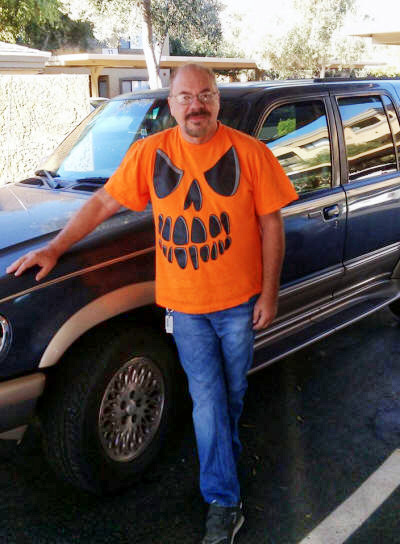
When I was five, I attended my first Halloween party. Prior to that, I
was unaware there was such a thing! as Halloween. I have no
memory of kids coming to the door for candy, or anything about
ghosts or witches, whatsoever. So I was a bit taken aback when my
mom put me in a costume (I have no idea what it was) and dropped me
off at a stranger's house. (I assume Mom knew them; but I had never
met anyone there.)
I remember wandering aimlessly among other puzzled kids, and
adults, all in costume. I remember a punch bowl and candy. But
mostly I remember waiting patiently for it to be over, so I could go
back home and resume my life.
The next year, and thereafter throughout my teenage years, I went
trick-or-treating every year. But it was always strange to me. I
knew that "Trick or treat!" was supposed to be a threat, but since I
was expressly forbidden from actually playing any "tricks" the
threat seemed to be singularly empty.
As years passed and I had more opportunities to talk with adults
about their Halloween experiences—especially my grandfather—I had
to face a couple of anomalies.
Assuming they were telling the truth, the adults had gotten
into far more serious mischief in their childhoods than I would ever
contemplate; and
I was supposed to like candy, but I really don't.
I've been told I was "born old" and this is probably an example
of this. I have no problem with others celebrating Halloween (as
long as no one is harmed in the celebration) but I have been unable
to manifest the level of excitement that everyone else seems to
enjoy.
This is especially a problem for me as a gay man, because
apparently Halloween is also known as "Gay Christmas" and many, many
gays and lesbians go all out. (This is similar to the way
the Oscars are sometimes referred to as the "Gay Superbowl". I don't
get excited about the Oscars, either. And I've never watched a
Superbowl; I'm not even certain what sport is played in it.)
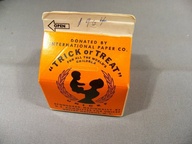
About 1965 I discovered UNICEF, the United Nations Children's Emergency
Fund. I actually don't remember how I heard of them, but their
"Trick Or Treat For UNICEF" was the first time I got really excited
about Halloween. The idea was to get these coin banks from UNICEF,
made of cardboard and shaped like milk cartons. Then, when we showed
up at someone's door, we would say, "Trick or treat for UNICEF!"
and, instead of candy, accept coins that would, eventually, help
starving children around the world obtain food and medicine. We
weren't supposed to ask for candy, just the coins…which was fine
with me, but surprisingly I had a lot of trouble convincing my
little sisters to join in. Louise, in particular, was only willing
to participate if she could also get candy.
So we went from door-to-door in our costumes, and collected some
$24 for UNICEF, and my sisters got some candy and even though I
didn't want any, a couple of parents demanded I
accept it in addition to the coins.
The nicest part of trick-or-treating for me? Walking alongside
the ocean highway in the dark with my friends, telling spooky
stories.
The best documentation comes from the Church, so their claims
that Halloween originated as part of a three-day celebration of
those who have died—saints—in which November 1st is All Saints Day
(a holy day of obligation, which means Catholics must attend Mass on
that day), and November 2nd is All Souls Day. October 31st was
celebrated as the evening of "All Saints" (known then as "Hallows".
October 31, therefore, is All Hallows Evening, shortened over the
centuries to Halloween.
But the Celtic pre-Christians are very likely to have celebrated
October 31st in their indigenous religion. This has carried over
into Wicca, where October 31st is celebrated as
Samhain.
The Church, of course, has a long history of making itself more
palatable to indigenous people by providing replacement holy days
for forbidden, "pagan" feast days that occur on the same day and
include many of the same features. That's how Christians ended up
celebrating the birth of Jesus by taking a tree into their homes,
the Christmas Tree having been a ritual associated with a Germanic
mid-winter holiday.
Since the Church also demonizes the religion it replaces, the
nature worshippers that preceded Celtic Christianity became
"witches" and tales of their lurid rituals led directly to the
witch-burning craze a few centuries later. These rituals were
"documented" by priests who admitted they had never attended one,
and in retrospect, seem to have no bearing on reality.
From the "tricks" performed by my grandfather as a boy (which
included literally setting houses on fire), to the ones my
contemporaries claimed to have done (setting fire to a bag of dog
poop and leaving it on someone's porch, was a favorite; wrapping
toilet paper around a house was another), to the ones my kids'
friends did (jumping out of bushes to scare younger kids), one sees
a clear path to a less dangerous celebration than Halloween
previously was.
Kids are also tougher to scare. Though I guess when one never
knows if today will be the day that a classmate comes to
school with daddy's AK-47 and blows them all away, it's a little
tough to get goose bumps over a pumpkin.