|
By: Paul S. Cilwa |
Posted: 4/28/2026 |
|
Page Views: 92 |
| Hashtags: #HistoricalFiction #LucianOfSamosata #Antioch #Ephesus |
| Lucian's first trip across the Mediterranean to Ephesus. |
| Estimated reading time: 14 minute(s) (3224 words) |
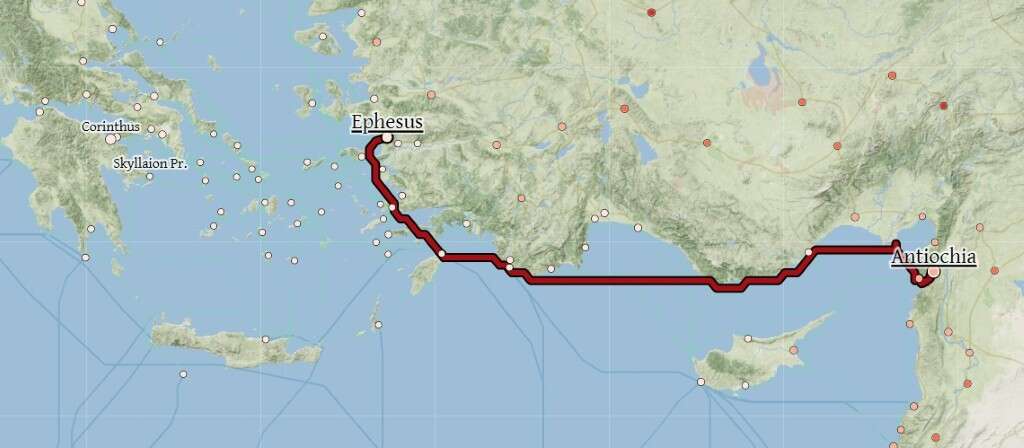
Demetrios pointed to the Aphrodite's Favor—a merchant coaster of perhaps eighty tons, her hull
painted a weathered blue-black, her single square sail furled against a wooden mast that rose from
the middle of the deck like the trunk of a petrified tree, all glowing gold in the flickering
torchlight. "That's the one we want," he advised Lucian. "I've traveled on her before."
Lucian and Demetrios presented themselves at the dock in the pre-dawn darkness, carrying only what they could manage on their
backs: each had two tunics, a mantle, a pair of sandals, and a small sack of bread, cheese, dried
figs, and walnuts. Demetrios had had the foresight to buy watered wine in a sealed bladder; Lucian
had a bronze cup and a hope that fresh water would be available. The ship was being loaded by
torchlight. Three merchant traders were aboard, overseeing the placement of their goods: one had
amphorae of wine, carefully nestled in straw; another had bolts of cloth wrapped in waxed linen;
the third had brought, mysteriously, a large cargo of what appeared to be garum, the pungent
fish-sauce that Romans used on everything. The smell would be inescapable, they would soon learn.
But they would also grow accustomed to it.
Captain Nikias was a stocky man with a
beard like iron wool, standing at the gangway and accepting payment from merchants who were loading
their goods. He had sailed this route—Antioch to Ephesus along the coast,
stopping at Rhodes and Cos—seventeen times, he told them. He charged them each three drachmas for
passage, asked no questions about where they were from or where they were going,
exhibited no interest when Lucian tried to tell him anyway, and told them to go on below.
Then the captain began shouting orders. There were perhaps fifteen crew: a pilot
who stood near the steering oars at the stern, a bow officer, three sailors
working the rigging, and a dozen others whose exact functions Lucian could not determine but who
moved with the practiced efficiency of men who had worked together many times. The sailors were a
mixed lot: one was clearly Greek, one appeared to be Egyptian with the dark, fine features of the
Nile, and the rest were a collection of Syrians and other men from ports unknown. They spoke to each
other in a rough hybrid tongue, a mixture of Greek with the vocabulary of the sea—words Lucian had
never learned in all his schooling.
All Aboard!
The ship itself, now that he could see it in the growing light, was larger than it had appeared
from a distance but still somehow fragile. The hull was built, he learned later, of pine and fir,
the planks sewn together with wooden dowels and linen rope, caulked with pitch. There were no
nails, or almost none. The whole thing flexed and gave slightly, which was supposed to be
good—Lucian had heard wooden ships that were too rigid tended to split.
The deck was an open expanse, perhaps forty
feet long and fifteen feet across, with the mast rising from its center. At the bow was a raised
platform, the proreum, and at the stern, where the captain stood now, was the hind, a
higher structure where the steering oars were mounted. Most of the deck was open, unshaded,
unprotected.
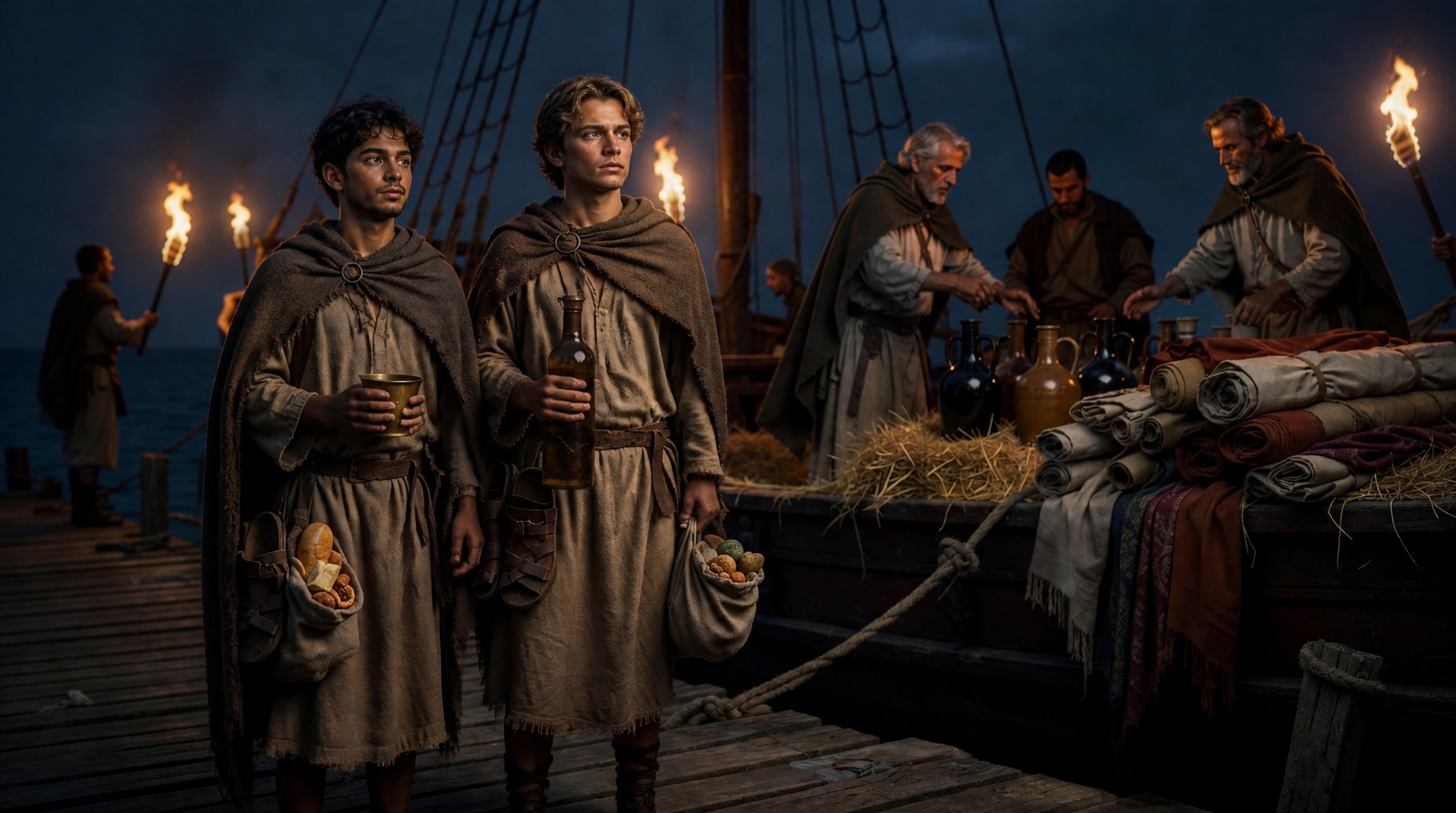
Lucian and Demetrios were directed below, through a low hatchway, into the hold. The air that hit
them was indescribable—the smell of bilge and garum and something ancient, as if the ship had
been rotting from the inside since it was built. Their eyes watered. The hold was divided into
compartments by wooden walls, and into these compartments the cargo had been loaded: amphorae
secured with ropes, bales of cloth, baskets of produce. There were perhaps a dozen other passengers
already there, and more would come. No one was assigned a spot. Lucian and Demetrios simply found a
corner between two wine amphorae and a shipping crate, laid out their cloaks on the wooden
floor—the only bedding they would have—and claimed the space.
An old man was already camped near them, an Egyptian or possibly Nubian, thin as a locust and
entirely unconcerned with the discomfort. He had a clay lamp, by which he was reading—actually
reading, from a small papyrus roll. When he saw Lucian's surprise, he smiled, showing four
remaining teeth. "I always bring the same book," he said in accented but clear Greek. "I've
read it forty times. But the sea is long, and a man needs something to do besides think about
dying."
"Do we?" Lucian asked. "Die at sea, I mean. Often?"
"Never more than once!" the old man chuckled. "But Captain Nikias is good.
He stays close to the coast, and he
knows the winds. We'll hug Cyprus, then Rhodes, then work our way up to Ephesus. Spring is the safe
season. You'll arrive in Ephesus wondering why you were ever afraid."
Lucian hadn't been afraid. But now he found himself oddly disquietened
Other passengers filtered in as the morning progressed. There was a widow traveling with her son,
who was perhaps eight; a slave woman belonging to one of the merchants, tasked with watching over
some kind of cargo; two Roman soldiers, probably minor functionaries being transferred; a merchant,
a nervous man from Laodicea who kept checking on his goods; and three or four others whose
stories Lucian never learned. No one had cabins. Everyone slept in the hold, or on the open deck if
they preferred fresher air despite the risk of suddenly inclement weather.
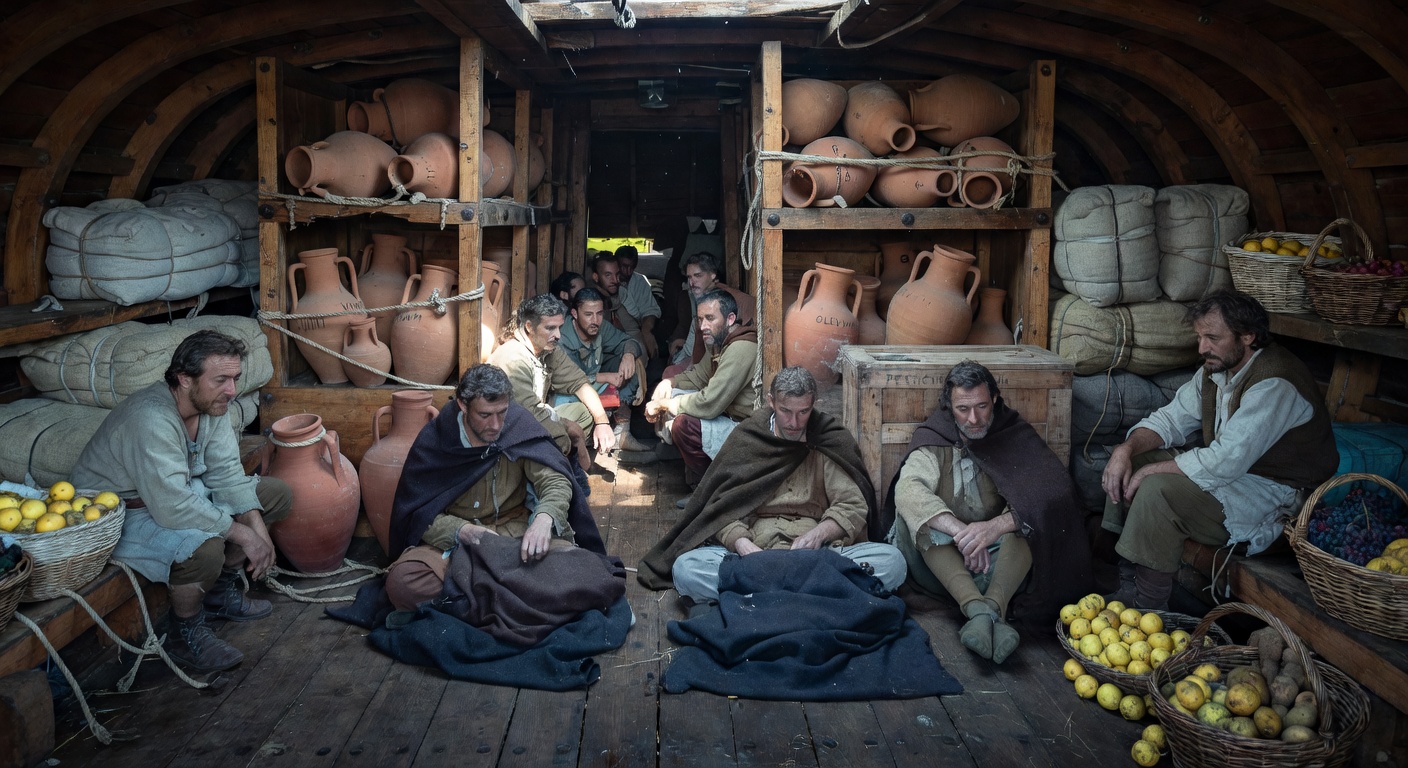
By mid-morning, the loading was complete. Captain Nikias came below and made a brief announcement:
"We sail with the tide. The crossing should take nine to twelve days if the wind holds. Fresh
water will be rationed—fill your containers now from the large barrel near the hatchway. Food is
your own responsibility. If you get sick, move to the rail and be quick about it, or clean up after
yourself. If you see anything strange in the hold—rats as big as dogs, water leaking where it
shouldn't, cracks in the hull—tell one of the crew immediately. Any questions?" There were
none. The captain returned to the upper deck.
Lucian and Demetrios filled their cups from the water barrel, which tasted of wood and rust but
was, at least, cold and wet. They sorted through their provisions—already the bread was hardening, and Lucian
realized with a start that they would need to be careful. Twelve days was a long time. They should
have bought more. They should have bought dried fish, at least, or more cheese. Oddly,
at the thought of a food shortage, Lucian was struck by sudden hunger. He could easily envision
himself gulping their whole stash down at once. "So, this is what starvation is like," he thought.
It had been five hours since he'd had breakfast.
They returned to the hold and with nothing else to do, tried to nap;
but sleep was impossible in the daytime noise and the
thick, unmoving air. So Lucian climbed back onto the deck and began to explore. The
Aphrodite's Favor was a revelation. He had never understood, in all his years in Samosata,
what a ship really was—not a thing that floated so much as a thing that pushed against the world,
a will of wood and rope and human effort imposed upon the sea. The mast was thick as a man's body
and rose what seemed like an impossible height, perhaps sixty feet, with a wooden platform halfway
up for the lookout to stand. The square sail was enormous when furled, a bundle of linen the
color of old cream. The rigging was a web of ropes, each with a specific purpose, and the sailors
moved among it with an ease that suggested they were more at home in the air than on solid ground.
The bow was pointed and reinforced, and from it extended a wooden figurehead—a woman with flowing
hair, presumably Aphrodite herself, badly weathered and missing one eye. There were also eyes painted on
the hull just above the waterline, as Lucian had noticed when he boarded. He had read in Homer about
such things, but seeing it was different; it made the ship seem almost alive, a creature that had
consented to carry humans but retained its own mysterious purposes.
The stern held the steering mechanism—two large wooden oars, one on each side, each long enough to
require a team of men to move. There was a small shrine there, too, a wooden cabinet with a clay
figurine of Poseidon inside, which someone had garlanded with dried flowers. Captain Nikias caught
Lucian looking at it and nodded approvingly. "We made an offering at dawn," he said. "The
god is merciful, but there's no mercy without respect."
By early afternoon, the tide was right, and the Aphrodite's Favor began to move. Lucian felt
the subtle shift, a loosening of the ropes, a change in the light as the vessel swung away from the
dock. The crew worked in practiced silence, and then the sail was being raised—a slow ascent of
white linen, fighting against its own weight and the wind that now began to fill it. There was a
sound like the ship breathing in, and then they were moving, actually moving, the shore beginning
to recede.
Lucian stood at the rail and felt something shift in his chest. He had left Samosata on foot, but
that had felt like running away, small and almost shameful. This was different. This was departure as a
cosmic principle—he was moving away from everything he had known, and the movement was not
something he was doing but something that was being done to him and around him, by forces older
than men. The shoreline of Seleucia grew small. The harbor became a toy. The land
seemed to dissolve. There was only the ship, the sea, and the wind.
Demetrios appeared at his elbow. "Nine to twelve days," he intoned as he gazed over the water.
"Except for the next water stop."
Lucian's thoughts were further off in the future. Ephesus is the
gateway. Ephesus is where the orators speak. Ephesus is where I
can learn to change the world with words.
First Night
The first night at sea was less entertaining than he had expected, despite having been forewarned by
Demetrios. The ship, which had seemed stable in the harbor,
was never still—a constant gentle rocking that seemed harmless until one was lying on the
wooden deck trying to sleep and realized that one's entire body was in motion, that there was no
fixed point anywhere, that the floor itself had betrayed the concept of floor. The widow's child
would not stop crying. The soldier from Laodicea was asleep and snoring in a way that
seemed almost defensive.
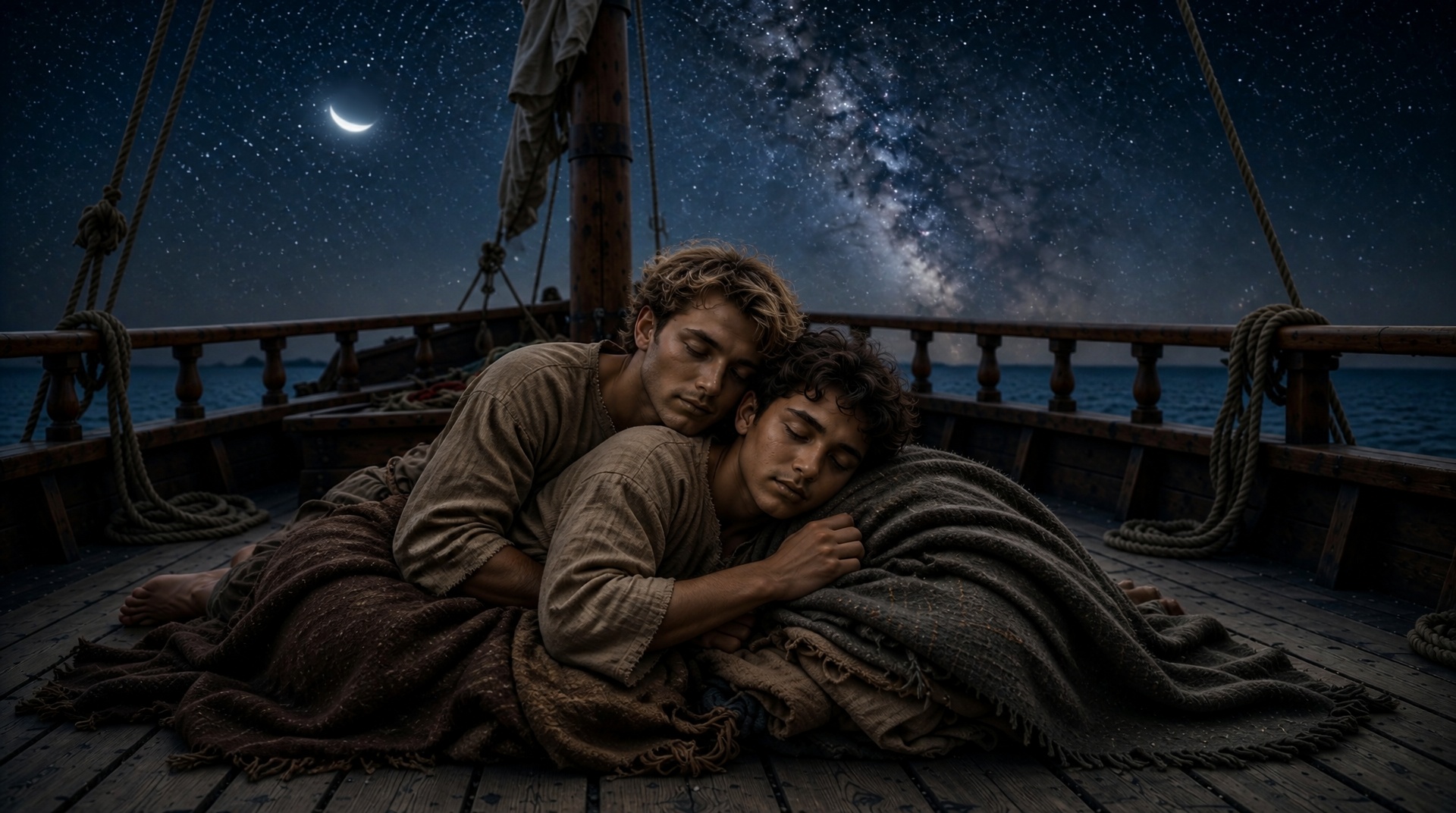
Demetrios shook him. "By Zeus," he muttered in disgust. "I'm going to sleep on deck." He rose and Lucian followed him.
The air outside was blessedly fresh with just a slight salty tang. They found a spot on deck as yet unclaimed,
and lay alongside each other, spooning to provide more stability against the rocking of the deck.
Lucian lay still and tried to count the stars. The old Egyptian was
right—the fear was different than he had expected. It was not sudden or dramatic. It was a slow,
creeping realization that the normal rules of the world had been suspended, that he was entirely
dependent on the skill of Captain Nikias and the grace of Poseidon, and that there was nothing he
could do about either. After an hour of this, he found it strangely comforting, and fell asleep.
The next day the seasickness hit him, then left. He discovered if he stared at the distant
shore, it seemed to help settle his stomach. The wind held from
the northwest, steady and reliable, and the ship found its rhythm. They were sailing close to the
coast, as promised, and the land was never far away—mountains visible on the horizon, small
harbors where the ship did not stop but could stop, a continuous ribbon of possibility. The ship's
routine established itself. The crew changed watches with bells. Water was distributed in measured
amounts. The three merchants disappeared into whatever compartments they had claimed and seldom
emerged, except to go to the bow and use the "seat toilet" suspended over their wake.
On the second day, Lucian discovered that one of the cargo holds contained not just merchandise but
animals—three goats and two pigs, intended for a merchant in Rhodes. They were kept in a wooden
pen and they were miserable. The pigs in particular seemed
to be in a state of permanent outrage at their situation, squealing in tones that could probably be
heard in Samosata. The goats were calmer but occasionally attempted to butt their way through the
pen. A young slave, a boy barely older than Lucian, had been assigned to feed and water them. It
had to be, Lucian thought, the worst job on the ship.
The food situation stabilized into a kind of routine of diminishing satisfaction. Lucian and
Demetrios ate their bread and cheese sparingly, supplemented by shared meals with other
passengers—the widow had brought some dried fish and was willing to trade for bread, the merchant
from Laodicea had fruit preserves in a sealed jar, the old Egyptian apparently needed almost
nothing and existed on a diet of bread and resignation. The water remained precious; one learned to drink
sparingly, to rinse one's mouth rather than swallow, to save the body's moisture for moments of
genuine thirst.
Rhodes
On the fourth day they put in at Rhodes, dropping anchor in the harbor briefly to take on fresh
supplies and drop off cargo. The crew took several hours for what appeared to be important
business; the captain himself went ashore. Lucian and Demetrios decided to walk around,
longing as they were to stretch their legs on solid ground.
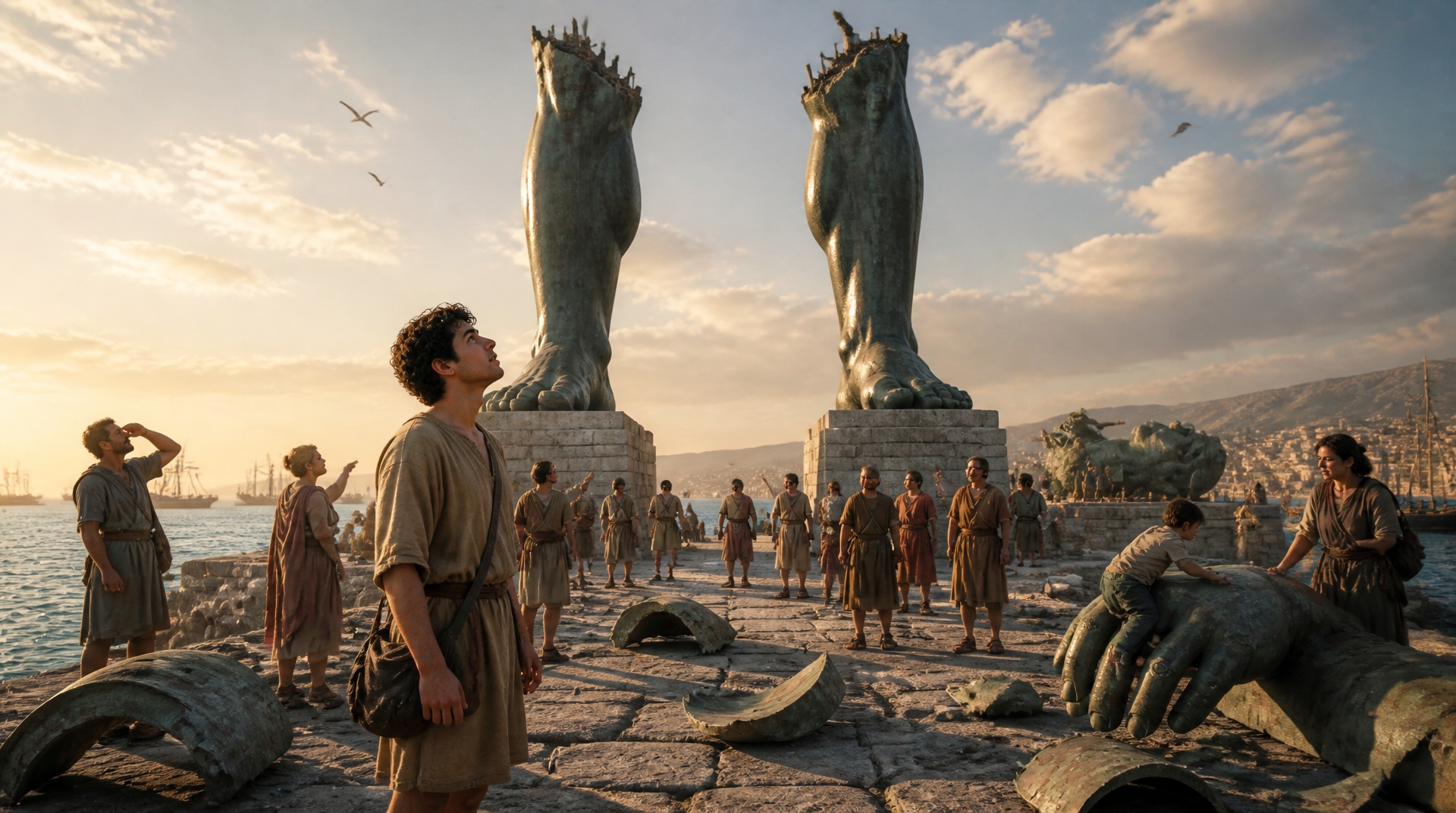
Lucian wanted to visit the ruins of the famed Colossus of Rhodes, a giant statue
that had overlooked the harbor for centuries but had been toppled by an earthquake 350 years before.
It had been snapped off at the knees; but even that was enough to make it a major tourist attraction.
Demetrios begged off, saying he'd already seen it and wanted to catch up with an old friend. When
Lucian offered to accompany him, Demetrios laughed. "I don't think you'd get along that well, to
be honest," he said. "Don't worry about it. I'll meet you back at the ship."
Lucian went to see the Colossus's calves and feet, and found himself more amused at the reactions
of the other tourists than at the ruins themselves, thinking if it had stayed up during that earthquake,
now, that would have been impressive!
Lucian returned to the ship before Demetrios. In fact, he was beginning to fear his friend might
miss the afternoon tide, and the captain had been clear that they would not, could not, wait for anyone.
Finally, Demetrios appeared, looking tired but positively glowing. And he had a sack
with him.
"Food!" he called out to Lucian. When he'd gotten on board, he continued. "My friend was, uh,
cleaning out his pantry and he gave me
some extra bread and cheese. And figs! And some dried fish! So we won't have to worry about
food for a while!"
Lucian was surprised but grateful. He knew Demetrios was well-traveled despite his youth,
but hadn't expected him to have friends in Rhodes, much less friends who could afford to be
so generous.
Back at sea, with the wind still favorable, Lucian spent the hours mentally reciting Homer,
lying on the deck between the mast and the rail, watching the sky change in its slow. majestic way. The wind was
constant, making a kind of rushing whisper. The water, seen close, was not blue but a complex
combination of shades—green in the shallows near the coast, then a deeper blue-gray, and farther out a darkness
that suggested infinite depth.
On the ninth day, with Cyprus long behind and the coast of Asia Minor growing more substantial, the
lookout shouted a warning. A sail was visible on the horizon—another merchant ship, smaller than
the Aphrodite's Favor, approaching fast. For a moment there was tension among the crew.
Piracy had been reduced significantly since Pompey's campaigns two centuries before,
but they still existed. Captain Nikias ordered the speed increased—the sail was adjusted, and the ship
seemed to lean forward with effort. But the other vessel made no hostile move, simply passed at a
distance, and the moment of tension passed. Lucian was almost, but not, quite, disappointed.
He had played pirates as a child. But, as an adult, he knew they were nothing to play around with.
By the tenth day, the coast was so close they passed fishermen in small boats, and on the
eleventh day, they could see the ruins on a headland—the remnants of an ancient city, probably
Greek, apparently dead. The lookout called that they were approaching Cos, and then Samos, and finally,
on the twelfth day, the peaks of the mountains above Ephesus became visible.
Ephesus At Last
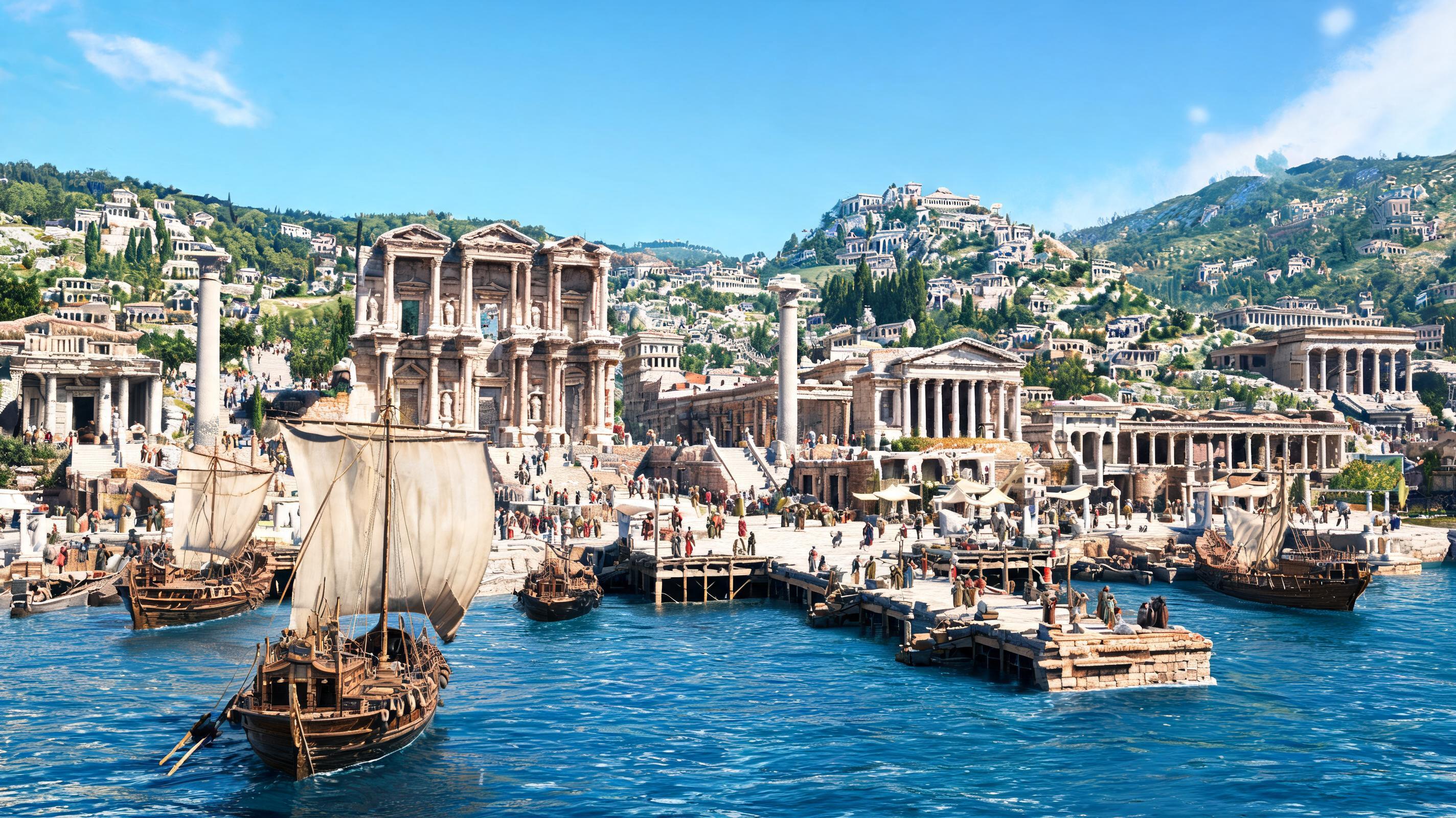
Lucian woke early that morning and ran immediately onto the prow. The city was still distant,
but it was real now, tangible, a collection of white buildings spilling down from a height toward a
harbor that seemed impossibly busy. Smaller boats surrounded the Aphrodite's Favor,
merchants from the shore seeking to make sales, harbor pilots offering their services. The crew
moved with purpose—the sail was being adjusted, the steering oars were being manned, and above it
all, Captain Nikias stood at the stern and grinned a grin that suggested satisfaction.
Ephesus was coming closer. Lucian could smell it now—the smell of a large city, a mix of humanity
and commerce and saltwater and hope. He had survived the crossing. He was a different person than
he had been twelve days ago in Seleucia! Or so he felt. He was no longer merely a boy from Samosata, no
longer merely the failed apprentice of a sculptor. He was someone who had crossed the sea!
And he had arrived.
Demetrios appeared beside him, and pointed at the city. "We made it!" he exclaimed.
"We did!" Lucian agreed. And then, looking at the city, at the harbor, at the crowds of people
moving with purpose along the waterfront: "But my journey's not done yet. This is just the
beginning."
Demetrios grinned as if he knew something Lucian did not. "You have no idea," he chuckled.