|
By: Paul S. Cilwa |
Posted: 4/30/2026 |
|
Page Views: 83 |
| Hashtags: #HistoricalFiction #LucianOfSamosata #Smyrna #PlatonicPhilosophy |
| Lucian learns about Platonism at a lecture in Smyrna. |
| Estimated reading time: 15 minute(s) (3361 words) |
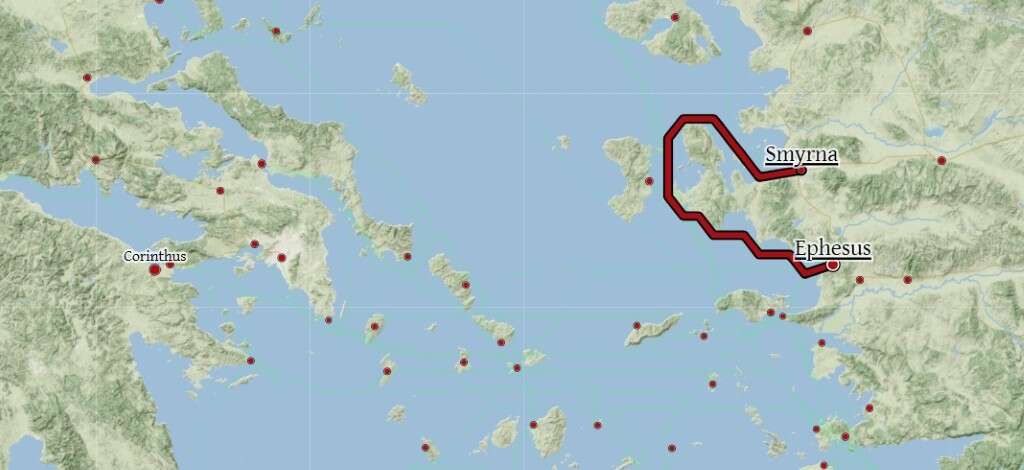
As the Aphrodite's Favor edged into Ephesus's harbor, the city revealed itself in
layers—first the Temple of Artemis on the heights, its marble columns catching the afternoon
light; then the theater carved into the hillside; then the crowded waterfront with its forests of
merchant ships, its din of dockhands and merchants and harbor officials who boarded even before the
gangway was properly lowered, checking manifests and collecting taxes.
Lucian stood with his few
possessions and took a deep breath; Demetrios, however, was already scanning the crowd with the ease of a
man who had business connections, and suddenly seized Lucian's arm with an urgency that suggested
inspiration. "There," he said, pointing to a man in an expensive himation of deep purple,
accompanied by a young slave. "That's Hippias—my father sold him wool last year, and he told me
if ever I was in Ephesus to look him up. Hippias!"
Demetrios ran off like an antelope, leaving his things for Lucian to guard. But, after joyously
hugging his father's business associate, and speaking briefly to each other, he returned. "Hippias
has invited us for dinner and to spend the night, in exchange for you telling funny stories at
dinner."
Dinner With Leaded Wine
Within an hour the boys found themselves in a house located conveniently near the shopping mall,
with terracotta floors, frescoed walls depicting scenes from the Odyssey. Lucian and Demetrios were
assigned a bedroom such as Lucian might have imagined a palace might have. It had an actual
bed, raised off the floor, so one might never have to fight a rat for sleeping space. And,
not only was it off the floor, but it was decorated with silver and had a mattress! Lucian felt
like he'd died and gone to Olympus.
A slave led Lucian and Demetrios to Hippias's bathhouse—a small, self-contained room adjoining the
house, with a hypocaust system that made the floor warm to the touch and heated the air to a
thickness that reminded Lucian instantly of the public baths in Samosata, except here there was no
crowd, no strangers sitting shoulder-to-shoulder, no sponge-sticks being passed between men's legs.
Instead, there was only himself and Demetrios, and a slave attending them with bronze vessels of
warm water, olive oil in a glass flask, and two bronze scrapers polished to a gleam. The basins
were marble—actual marble, not the rough stone of public facilities—and the light came from oil
lamps set into niches in the walls, casting everything in a golden glow that felt almost sacred.
Lucian oiled himself slowly, almost ceremonially, aware that he was doing something he had never
done before: bathing in near privacy, in luxury, as if he were a man of consequence. As he scraped
the salt and grime of the sea from his body, long gray ropes of filth collecting on the marble
floor, he saw Demetrios doing the same beside him, and for the first time since leaving Samosata he
thought: This is what it means. This is what the sophist must have known—that there are places
in the world where a person can be clean, can be comfortable, can move through the world as someone
who matters. The warm water that the slave poured over him at the end felt less like washing
and more like an anointing, a transformation, and when he emerged and dressed in his clean
tunic—the one he had been saving for the crossing, now worn but at least fresh—he understood why
men in cities like this looked different, moved differently, spoke with that particular confidence.
They had been bathed this way. They lived their lives in rooms like this, in houses like this, and
such a thing changed you from the inside, made you believe you deserved to take up space in the
world.
Feeling magnanimous, when the slave boy who had cleaned them had led them back into the main house,
and the dining room, for dinner, Lucian smiled and thanked him. Demetrios looked surprised, but
said nothing until they were out of the boy's earshot and not yet within the hearing space of the
dining area. "You don't thank slaves," Demetrios whispered. "People will think you're a barbarian."
"I hope never to become so civilized as to have no manners!" Lucian pointed out,
but then they were being seated. A thick, heavy
wine was served. Lucian brought it to his lips expecting something like the thin, watered wine he
had grown up with, and that he and Demetrios had bought from vendors in the harbor—a
drink that tasted more of water than grape.
What hit his mouth instead was a shock of sweetness so concentrated it was almost another substance
entirely, a syrup that coated his tongue and throat, that seemed to carry within it not just the
flavor of grapes but the essence of summer itself, boiled down and intensified until it became
something transcendent. He swallowed, and the warmth of it spread through his chest, and for a
moment he simply sat with the sensation, aware that Demetrios was watching him with amusement,
aware that this was another marker of the gulf between his old life and this new one.
But almost immediately he felt a strange sensation in his gut. Not the warmth of alcohol, but
something more like a lead weight. He turned to Demetrios. "What is this? It's almost more
like pure honey than wine."
"It's called defrutum," Demetrios whispered back. "It's made by boiling half the liquid away
from the finest grape juice. But it has to be boiled in these special pots made of copper lined
with lead. The lead dissolves into the wine, which is where the extra sweetness comes from."
"Gods, no wonder I feel like I have a lump of lead in my gut!"
Demetrios laughed. "It'll grow on you." But Lucian decided that, no matter how sweet the richest
citizens of Rome liked their wine, he would avoid it where possible. Even now, he moistened
his lips with the stuff every now and then just to be polite.
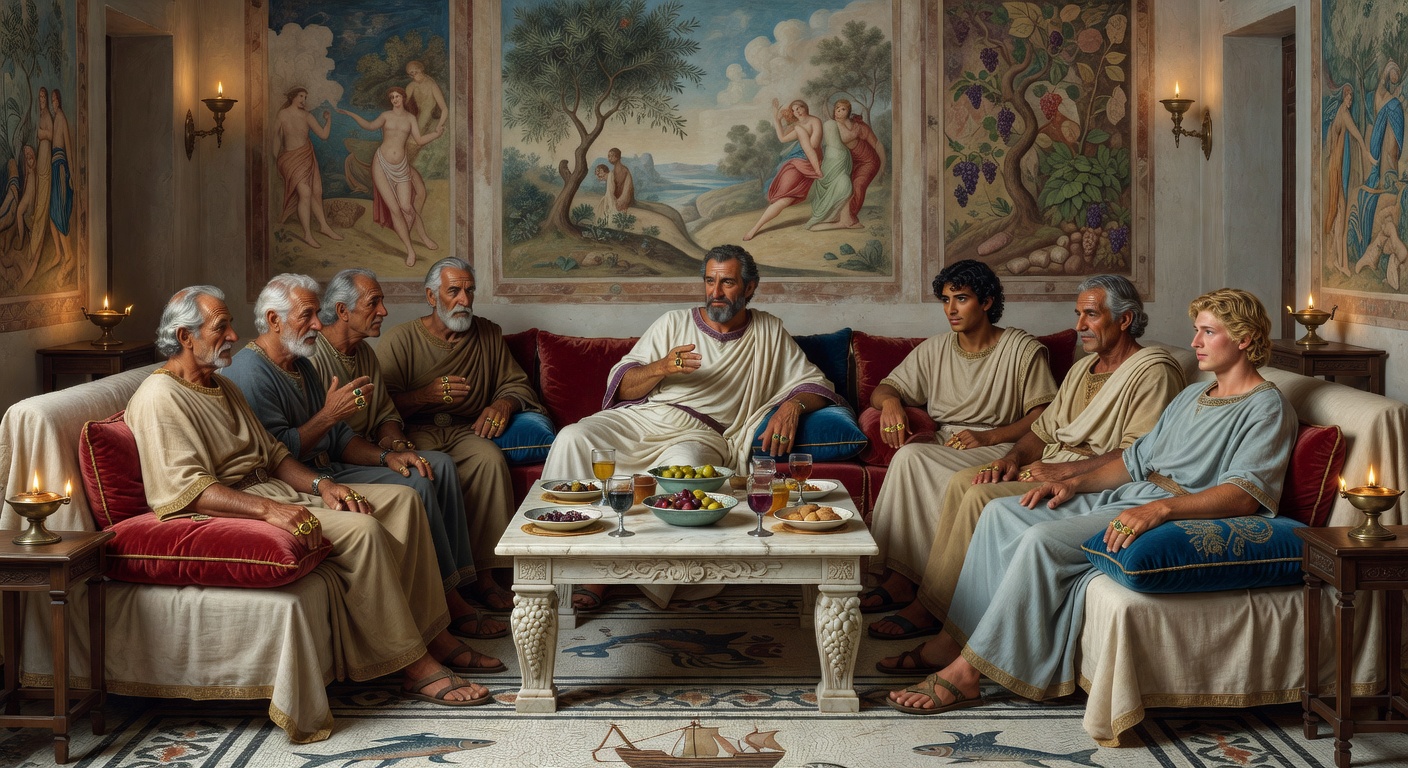
The triclinium where Hippias hosted his dinner was arranged in the traditional way—three couches
set in a U-shape around a low table, each couch laden with cushions and covered in fine linen.
Hippias reclined at the place of honor, and Lucian and Demetrios were positioned somewhat lower in
status, though still on the cushioned couches rather than on chairs, which meant they were being
treated as honored guests rather than servants or lesser folk. The other diners were merchants like
Hippias—men with the weathered faces of traders, their fingers heavy with rings, their
conversation peppered with references to shipments and prices and the state of trade routes to
India and Egypt.
The food arrived in courses: first, appetizers on small plates—olives the
size of a man's thumb, still warm bread torn into pieces, cheese crumbly and sharp, hard-boiled
eggs, small pastries filled with fish and herbs. Then came the main course,
which was an elaboration of fish—a whole mullet, roasted and dressed with garum and herbs,
accompanied by a salad of greens dressed in oil, and a dish of what appeared to be octopus cut into
pieces and stewed. Each dish arrived on serving platters, and slaves hovered constantly around the
couches, offering food, refilling cups, wiping hands with cloth napkins. The conversation flowed in a
rhythm Lucian was beginning to recognize—complaints about the harbor taxes, boasts about
successful voyages, gossip about other merchants, and increasingly, as the defrutum took effect,
louder laughter and more elaborate stories.
The light was beginning to fail outside the windows, and oil lamps were lit, casting the dining
room in a golden glow that made everything—the food, the wine, the men reclining at their
ease—seem like a scene from one of the old stories, a moment of timeless luxury that existed
outside the normal world. And then Hippias turned to Lucian, smiled, and said: "I understand you
just made your first sea voyage. Tell me, how was it?"
Lucian realized this was his introduction, and dove into a retelling of his and Demetrios' crossing
of the Middle Sea that emphasized his seasickness and misery to such an exaggerated degree that his
audience howled with laughter. And when the evening had finally come to an end, several of Hippias'
guests made it a point to invite him to have dinner with them "soon".
When all the other guests had left or retired to their guest rooms, Demetrios touched Lucian's
shoulder. "You must be exhausted," Demetrios said. "After all, last night we slept aboard ship!"
Lucian admitted he could barely keep his eyes open.
"Well, you go ahead to bed. I'm going to stay up with Hippias for a bit, but I'll be along
presently." So Lucian entered the huge room by himself, and plopped himself in the middle of the
bed. Then he realized that would be inconvenient when Demetrios joined him, so he picked the side
farthest from the door, and fell into a deep sleep, not even waking when Demetrios climbed quietly
into bed a few hours later.
After a typical breakfast of bread and a light wine, plus a fig!—Lucian and Demetrios made their way to
bid goodbye to their host. When they did, Hippias pressed a small sealed scroll into Lucian's hand.
"If you find yourself in Smyrna, I want you to visit my friend and a great teacher, Philostratos.
He's a Platonist, and with your talent for speaking, you might find his school to be right up your
narrow cobblestoned street."
"Thanks," said Lucian. "I have no idea how I'll ever get to Smyrna, but if I ever do—"
"If you need work," Hippias interrupted, "I could definitely use a scribe for a few days. I have
some work backed up, as the last one I hired for extra work wasn't actually that good."
"My father is a clerk," Lucian said. "I used to do scribe work for him all the time." (He didn't
mention that the work he did, copying, was for fun and his father hadn't paid him.)
"You're hired, then! You may as well stay in the room you slept in, last night. This will only be
for a week or so, but in addition to pay you'll have room and meals; and when you're done, you
should have enough to travel to Smyrna."
Lucian was grateful, but he didn't want to desert his friend. He turned to Demetrios, only to find
him winking at Hippias. Hippias, perhaps guessing Lucian's concern, immediately addressed it.
"Demetrios is always welcome here, as he knows," Hippias said.
And so the next week passed, as different as a sea voyage or overland trek as possible. Lucian
seldom left the household, as he kept busy transcribing Hippias' notes and receipts into organized
books of account. And, at the end of the week—one of those new, seven-day
weeks that were becoming popular in the east, rather than the traditional 8-day week of Rome—the
boys again gathered their things, bade Hippias farewell, and returned to the waterfront to find a
boat heading for Smyrna.
Shadows in Darkness
For only 2 drachmas each, Lucian and Demetrios were able to board another merchant coaster heading
directly up the coast to Smyrna. It was an overnight trip, and Lucian found himself sleeping better
at sea than he had in Hippias' exquisite bedroom. Of course, at sea, he again slept in Demetrios'
arms, while at Hippias's, Demetrios had stayed up every night late, visiting with their host, only coming to bed
shortly before the cocks began to crow.
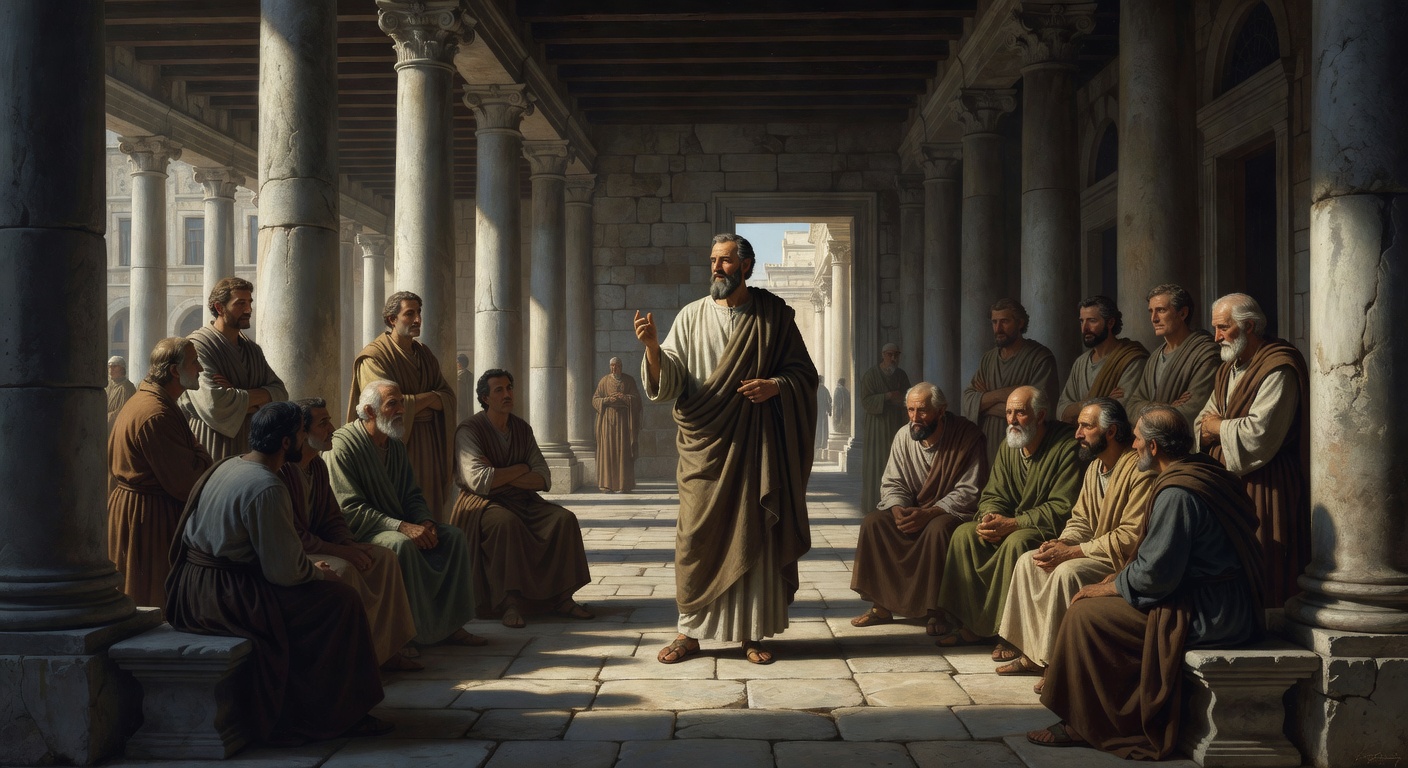
The gymnasium in Smyrna was not one building but a complex of them—a wrestling ground, a covered
portico for instruction, baths, and various smaller halls where men gathered to pursue
paideia, the cultivation of the mind. It was here, in the shadowed portico on the north side
where the afternoon heat could not reach, that Philostratos held his lectures on the intelligible
world. The scroll from Hippias got them in.
Philostratos was a man of perhaps sixty, with the bearing of someone who had never doubted his own
importance. His beard was trimmed to philosophical precision, his himation draped with the careless
elegance that comes from a lifetime of knowing one is being observed. His students—a mixture of
young men like Lucian and Demetrios, older merchants seeking intellectual respectability, and a few
serious scholars—sat or stood in a semicircle, the better to hear him expound on matters that, he
implied, were far too subtle for the ordinary mind.
He was speaking of Plato. Like anyone of his era, Lucian knew who Plato was—in general.
As a foundational father of Greek philosophy, as someone who any serious student of education
was expected to learn. But he hadn't ever read the actual doctrines. So today
would be interesting.
"Consider," Philostratos was saying, gesturing toward the pillar of light that fell across the
portico's floor, "what you see. This light, this stone, this very air we breathe—all of it is
shadow. Mere appearances. The world of becoming, never being, always in flux. But behind this
shadow-world, in the realm beyond sense and time, exists the true reality. The Forms—eternal,
unchanging, perfect. The Form of Beauty itself, of which all beautiful things are but pale
reflections. The Form of Justice, of which all just acts are imperfect copies."
Lucian snickered in spite of himself. "Does that make him a pale copy of the Form Of Nonsense?"
he whispered. Demetrios hushed him.
"A cup," Philostratos continued, "is a cup only insofar as it participates in the Form of
Cup-ness. The particular cup you drink from—it chips, it cracks, it breaks. But the Form of Cup
remains eternally perfect, eternally itself, in the intelligible realm. This is the teaching of
Plato, preserved and refined through generations of true philosophers."
Lucian found himself thinking about the cup from which he had drunk the defrutum at Hippias's
house. It had been made by someone—a potter in some workshop, probably local. The potter had not
been thinking about the Form of Cup-ness. He had been thinking about making a cup that would hold
liquid without leaking, that would be pleasant to hold, that would look good enough to sell.
The potter had succeeded, and the cup existed, and it worked. What did the Form of Cup-ness
add to this? What did it explain?
"The visible world," Philostratos continued, and now his voice had taken on the cadence of a
man delivering something profound, something that demanded reverence, "is like shadows cast upon
a cave wall. We sit in darkness, watching shadows move, thinking them to be reality. But the
philosopher—the true lover of wisdom—he turns around. He climbs out of the cave. He ascends
toward the light of the intelligible world, where the Forms exist in their perfect, eternal
glory."
A young scholar near the front raised his hand. "Master Philostratos, if the visible world is
merely shadow, how do we know the Forms exist at all? How can we have knowledge of something we cannot
perceive?"
It was a good question. Lucian leaned forward slightly, intrigued for the first time.
"Excellent," Philostratos said, and it was clear the young man had asked
exactly what Philostratos wanted to be asked. "Through reason, my student. Through the eye of the
mind, the noetic faculty. When you contemplate the Form of Justice, you are not seeing it
with these earthly eyes"—he gestured toward his face—"but with the intellectual vision of
the soul itself. The soul, before it was imprisoned in this body, beheld the Forms directly. Now it
remembers them. Philosophy is recollection."
The afternoon light had shifted, and now it fell across Philostratos's face, illuminating the
satisfaction there. He had answered the question to his own contentment. The young scholar was
nodding as if this made perfect sense. Around the portico, heads were nodding.
Lucian felt something like frustration rising in his chest. How convenient, he thought. How
perfectly convenient that the Forms were exactly beyond the reach of any verification, any
challenge. You could not point to them, could not measure them, could not test them. You could only
remember them, and if you could not remember them, well, that just meant your soul was too
imprisoned in the body, too distracted by the visible world. It was a system designed to be
unfalsifiable, to be beyond argument.
He thought back to the sophist in Samosata, who had come to the town and spoken with such power
that grown men wept. That sophist had not been talking about Forms or intelligible realms. He had
been talking about a blind man, about suffering, about the particular human tragedy of losing one's
sight. He had made his listeners feel something, had transported them into a story, had made
them see through words. That was real. That moved people. That was philosophy in the truest
sense—not because it was about the Forms, but because it was about us, about the world
in which we actually live.
The lecture continued. Philostratos moved on to discuss the nature of evil—it was not a positive
force, he explained, but merely the absence of the Good Form, as darkness is merely the absence of
light. It was elegant, in its way. It explained things. But it explained them at such a distance,
in such abstract terms, that Lucian could not help feeling that something essential was being lost.
When Philostratos finally concluded—with a gesture suggesting he was reluctant to descend from
these heights of contemplation back into ordinary time—the students dispersed. Some gathered
around Philostratos with further questions. Others filed out slowly, as if exiting a temple.
Demetrios began carefully rolling up his notes.
"Well?" Demetrios asked, noticing Lucian's expression. "What did you think?"
Lucian was quiet for a moment. Then he said, low enough that only Demetrios could hear: "If the
world is only a shadow, then Philostratos must be lecturing in the dark—and charging admission for
it."
Demetrios blinked, then let out a snort of laughter that he quickly suppressed, glancing back at
Philostratos, who had not heard. But Lucian saw something shift in his friend's face—a
recognition, perhaps, that Lucian's gift was not for abstract philosophy but for something else
entirely. For seeing through pretense. For saying what everyone was thinking but no one dared speak
aloud.
"Come on," Lucian said, standing and stretching. "Let's find something to eat. Something
real. Something we can actually taste, even if it's just a shadow."
Before they could step outside, however, Philostratos approached them. "How is my good friend,
Hippias?" And before they could answer, he added, "Come, you will be my guests tonight. I am anxious,"
he said, smiling at Lucian, "to hear how your trip across the Middle Sea went."
Lucian, of course, had never opened the sealed scroll, so had no idea what it had revealed.
But, always quick with words, he joked, "Certainly, Master. I believe I was visited by the
Form of Nausea."
Philostratos laughed, then grinned broadly at Demetrios. "And I want to hear from you every
little detail of Hippias' health. We'll do that after dinner."
As they walked out of the portico into the bright Smyrnaean afternoon, Lucian realized that he had
just stumbled onto something: the real power of words was not in explaining the world away into
intelligible realms. It was in describing the world as it actually was—with all its
contradictions, its concrete particulars, its absurdities—in a way that made people laugh, made
them see themselves and their pretensions clearly.
That might be a kind of truth worth pursuing.