|
By: Paul S. Cilwa |
Posted: 5/1/2026 |
|
Page Views: 78 |
| Hashtags: #HistoricalFiction #LucianOfSamosata #Smyrna #Stoicism #Philosophy |
| Lucian encounters Stoicism and discovers Demetrios' secret. |
| Estimated reading time: 12 minute(s) (2745 words) |
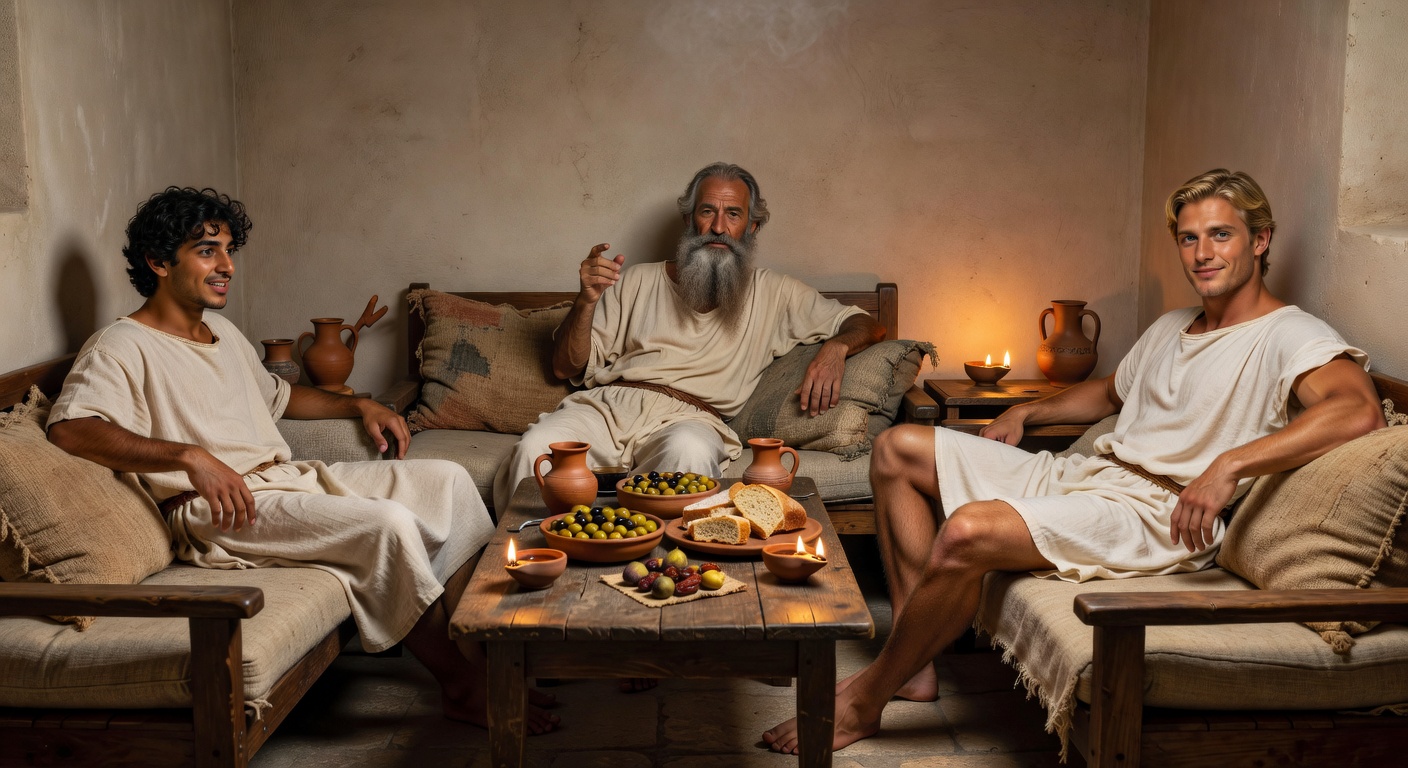
Philostratos greeted them with the warmth of a man welcoming old friends rather than new
acquaintances. He was dressed simply, in a plain himation, and he led them not to a formal
triclinium but to an informal dining space, a simple room with three couches arranged more
for conversation than ceremony. "I prefer this," he explained, "for the discussion
of ideas. The formal dinner is for merchants who need to impress. We are seeking truth,
and truth is most comfortable in modest rooms."
The meal was simple—fish, bread, olives, a light wine, watered properly and without
the leaden sweetness of defrutum. And Philostratos himself poured the wine, a gesture
that made it clear he did not consider himself above the work of hospitality. As they ate,
he turned to Lucian with genuine curiosity.
"Tell me about the voyage," he said. "Not the facts of it—any traveler can
recite those. Tell me about the experience. What did you learn about yourself?"
Lucian found himself hesitating. This was not the kind of question merchants asked. He was
used to people wanting entertainment, stories that were funny or dramatic or shocking. But
Philostratos seemed genuinely interested in the interior of the experience, the transformation.
So Lucian told him about the fear of the first night, the way the horizon expanded your sense
of the world, the moment when the fear shifted to exhilaration, the strange communion of
strangers sharing a dangerous journey.
As he spoke, he watched Philostratos's face. There was no condescension there, no sense
that Philostratos was waiting for Lucian to finish so he could deliver his own wisdom.
Instead, there was attention—real, intense attention—and when Lucian finished,
Philostratos nodded slowly.
"Yes," he said. "You understand something that not many do. That fear and transformation
are not opposites but companions. That the sea teaches what books cannot. You will go far,
Lucian, if you are willing to learn as much from what you encounter as from what you study."
Beside him, Lucian saw Demetrios relax slightly. There was something in that exchange that
Demetrios had been testing for—some approval or recognition. And now that he had it,
he seemed suddenly more at ease.
As the meal concluded, Philostratos turned to Demetrios. "I have some matters I wish to
discuss with you privately," he said. "If you can spare an hour? Lucian, you look
exhausted. I've had a room prepared for you. My slave Alexios will show you. Sleep well,
for tomorrow we have much to discuss."
The Night Watch
Lucian was led through the house to a small but clean room. The bed was modest, but after
weeks sleeping on ships and in inns, even the simplest bed felt like luxury. He fell asleep
almost immediately, and when he woke in the deep night—drawn by the call of nature—he
made his way toward what he thought was the latrine. Instead, he found himself in a narrow
corridor that opened onto the courtyard, and it was there, by the light of the dying moon,
that he saw them.
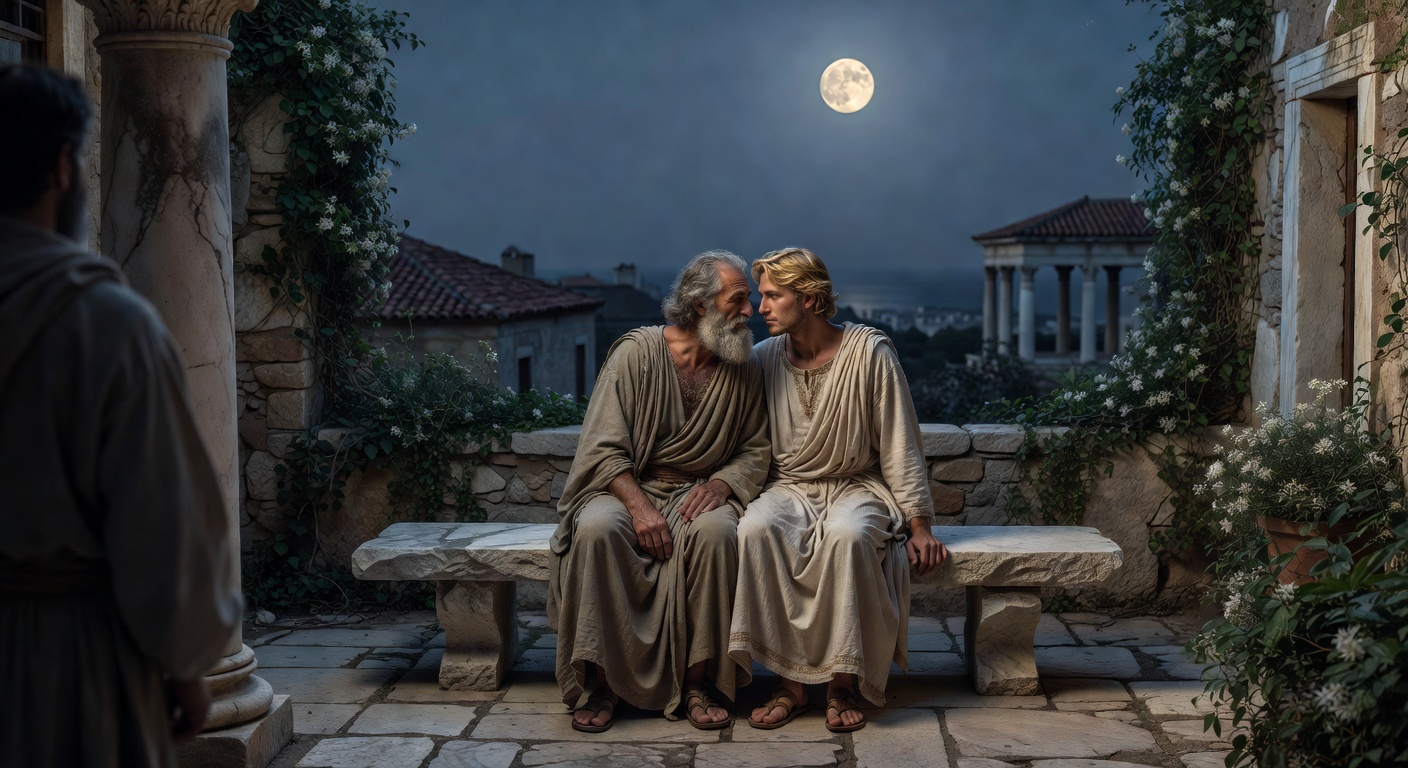
Philostratos and Demetrios were sitting on a stone bench near the herb garden, close enough
that their shoulders were nearly touching. Philostratos was speaking in low tones, his hand
gesturing slowly through the air, as if painting with words. Demetrios was listening with
an intensity that Lucian had never seen directed toward anyone except Lucian himself.
Lucian realized, in that moment, that he had misunderstood the relationship between his friend
and their host. Or rather, he
had understood it only partially. The way Demetrios had lingered with Hippias, the way he
had been eagerly looking for Philostratos in Smyrna, the way his whole demeanor had changed
when Philostratos appeared—this was not the behavior of a casual student visiting a
teacher. This was something else entirely.
For a moment, Lucian felt a twist of something in his chest. Not quite jealousy, but something
like it—a sense of displacement, of realizing that the companionship he had taken for
granted had depths he had not perceived. And then he understood something else: that Demetrios
had been protecting him, had kept this separate. Had been careful not to complicate their
friendship with complications of the heart.
Lucian retreated quietly back to his room. He did not sleep, but lay listening to the sounds
of the house, the distant murmur of voices, the slow passage of the night. When Demetrios
finally returned to the room—hours later, as the sky was beginning to lighten—he
did so quietly, trying not to disturb Lucian. But Lucian was awake, and he reached out in
the darkness and squeezed Demetrios's hand briefly. Just to let him know that he understood.
Even though he wasn't sure he did.
Demetrios held the hand for a moment longer than necessary, before turning and heaving a
contented sigh.
The Stoic Lecture
The next morning, Philostratos brought them both to a different part of the gymnasium complex,
to a lecture hall where a different philosopher was preparing to speak. "You should hear
all schools," Philostratos said, "not just my own. Otherwise, you mistake habit
for truth." It was a generous gesture, and one that suggested Philostratos was more secure
in his beliefs than Lucian imagined many teachers were.
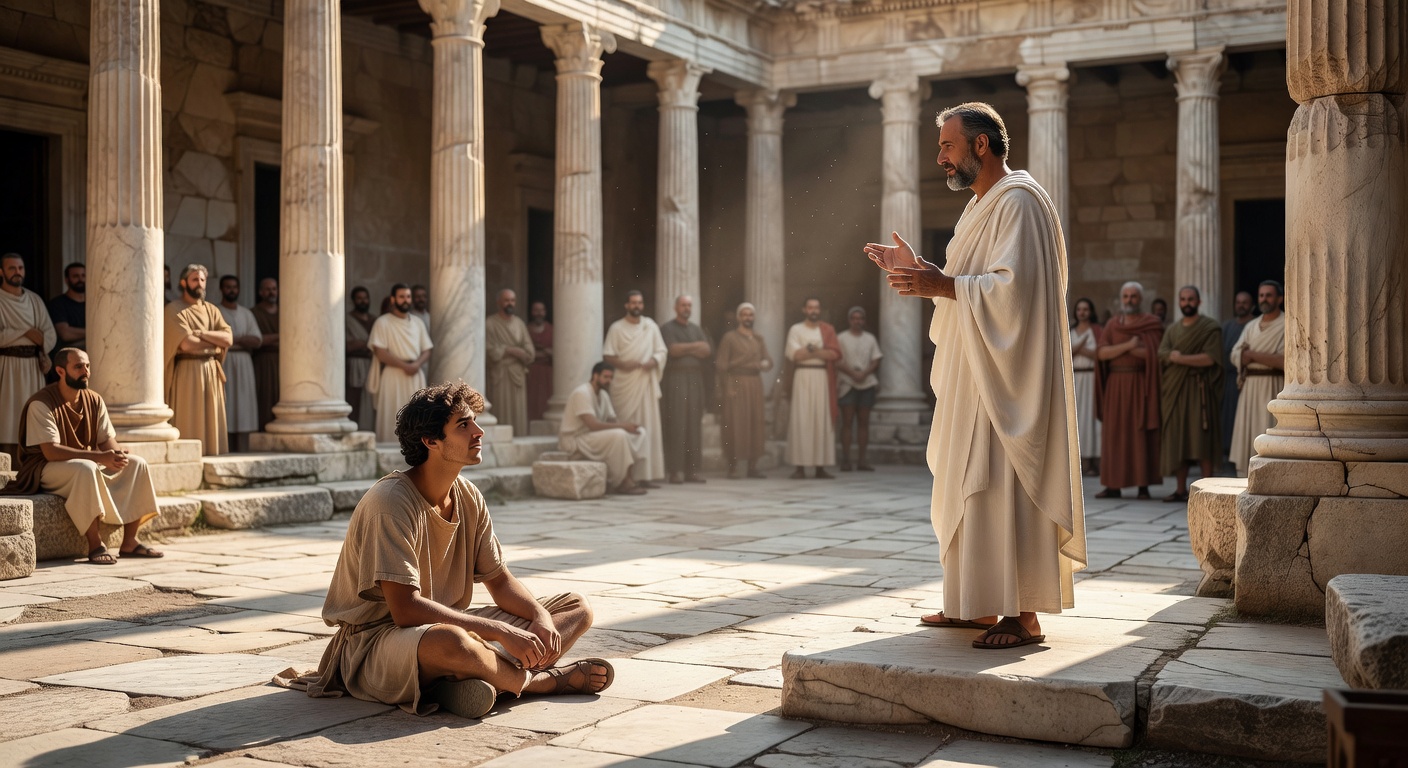
The Stoic lecturer was a man younger than Philostratos, perhaps forty, with the compact,
muscular build of someone who still practiced the athletic disciplines. His name was Epictetus,
not the famous freedman of that name, but a
follower of that school. When he spoke, his voice was sharp and clear, cutting through the
morning air like a blade.
"The Stoic understands one fundamental truth," Epictetus began, not with preamble but
directly, as if the lecture had been ongoing in his mind and he had merely begun speaking
his thoughts aloud. "You control nothing. Your wealth, your health, your reputation, your
very life—none of these are in your power. The only thing you truly control is your
judgment about these things. Your choice to accept or reject them. Your will."
Lucian found himself sitting forward. This was different from the Platonist's abstraction.
This was speaking about real things—wealth, health, death.
"A man loses his fortune in a storm at sea," Epictetus continued. "He despairs. But
the Stoic sage knows: the loss of money is not a misfortune. It is simply an event. A thing
that happened. The real misfortune would be to judge it a misfortune, to allow his mind to be
troubled, to fail in virtue because of externals."
Lucian's face took on a cynical expression as the image of the merchant ship
they'd been on, had it been struck by a storm, surrounded by waves, with
goods sliding toward the sea, men shouting, and the captain crying out to Poseidon for
mercy—the idea that this was merely an event that would somehow be improved
by remaining untroubled—suddenly seemed darkly comic.
"Virtue is the only true good," Epictetus said, and his voice had taken on the cadence
of conviction. "And virtue lies entirely within your power. It is your choice. And therefore,
the wise man is never defeated. His slave master can break his legs, but cannot touch his
will. His enemy can take his home, but cannot take his virtue. He is free in the truest
sense, because freedom is not about external circumstances. It is about accepting the will
of the universe and aligning your own will with it."
Lucian listened, and while he found it somewhat more compelling than the Platonist lecture, because it was
grounded in struggle, in the real difficulty of being human—there was something in it
that troubled him too. The idea that external things did not matter, that a man should accept
everything with equanimity—it seemed to remove the possibility of change, of fighting
back, of transforming the world instead of merely accepting it.
When the lecture ended, Philostratos led them both to a quiet corner of the gymnasium.
"What did you think?" he asked Lucian.
Lucian considered the question carefully. "I think," he said slowly, "that he is saying
something important about not being defeated by circumstance. And that seems true. But I also
think—if nothing external matters, if we should accept everything the universe sends us,
then what is the point of anything? Why struggle? Why try to change anything? Why even become an
orator, if words don't matter?"
Philostratos smiled, and it was the smile of someone who has just seen something he was hoping
to find confirmed. "You think well," he said. "Both the Stoic and I have discovered
something true about the world. But truth is not simple. The Stoic truth is that we cannot
control outcomes, only our response. My truth is that behind the apparent world lies a deeper
reality. Both are partial truths. Neither is the whole."
"Then what is the whole?" Lucian asked.
"That," Philostratos said, "is what you will spend your life discovering. If you are
fortunate."
The Commission
Over the next days, a pattern established itself. In the mornings, Lucian would attend lectures
in the gymnasium—sometimes Stoic, sometimes Platonic, once or twice the lectures of a
Skeptic who seemed to think that nothing could be known for certain, which struck Lucian as
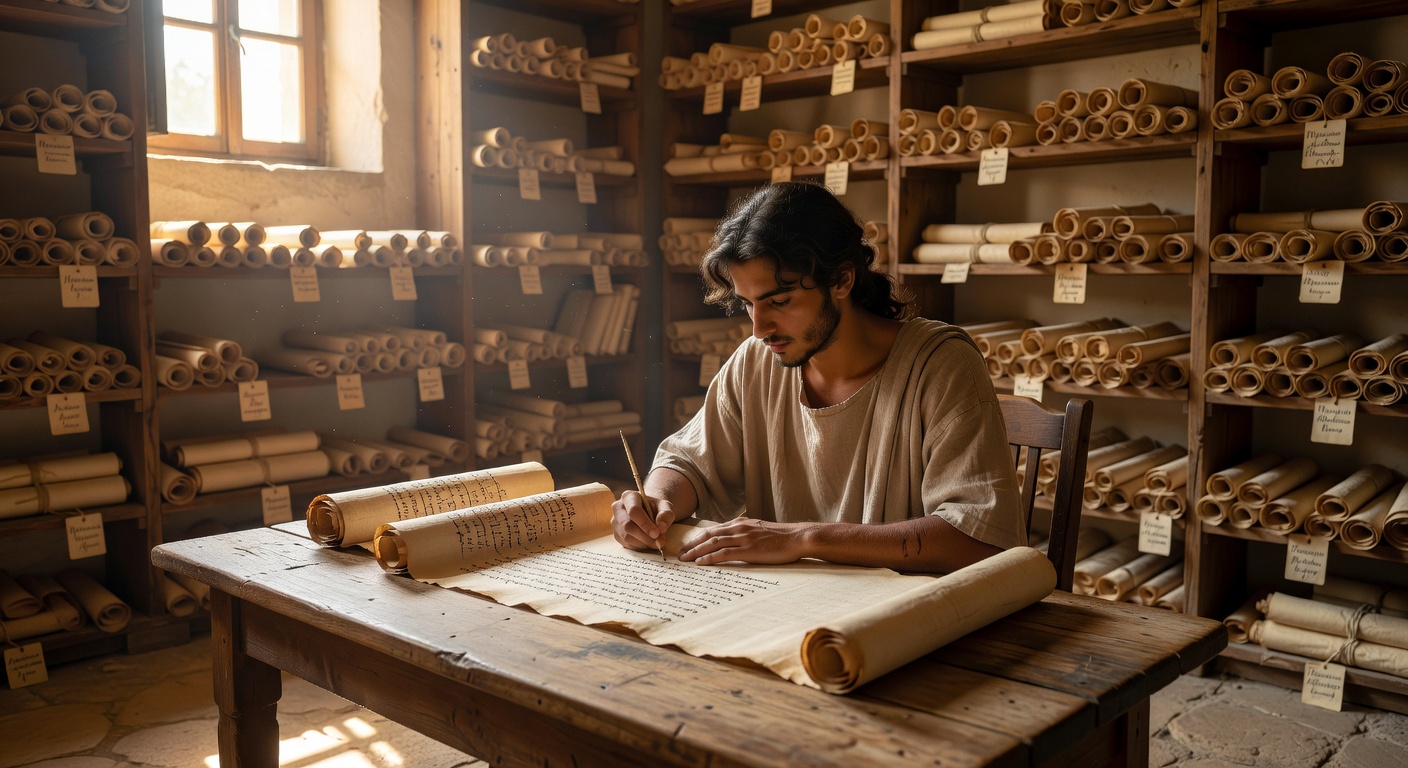
an elaborate excuse for laziness. In the afternoons, Philostratos set him to work as a scribe.
Philostratos had a considerable library, and he was engaged in what he called "the great work
of preservation." There were copies of texts he had collected over decades, and some of
them were becoming difficult to read, the papyrus yellowing, the ink fading. He wanted them
transcribed onto fresh papyrus, and he had taken Lucian on specifically for this work.
"You have neat handwriting," Philostratos said, examining Lucian's first day of work,
"and more importantly, you have patience. A scribe without patience is merely a man with a
writing implement, creating useful copies of things he does not understand. But you, I can
see, are reading as you copy. You are engaging with the ideas."
Lucian had indeed been doing this. It was impossible not to, when one was copying out
Platonist commentaries, fragments of the pre-Socratics, medical texts, and poetry. His
fingers were becoming stained with ink, and his eyes were beginning to ache by evening,
but his mind felt like it was being fed, for the first time since he had left Samosata.
The work came with payment, and with lodging. Philostratos had given Lucian his own small
room, with a proper bed and a small desk where the transcription work took place. Demetrios
continued to sleep there as well, though the bulk of his nights were spent elsewhere. They
did not speak about this, but there was a gentleness between them that had not been there
before, a kind of mutual understanding.
It was during the second week of Lucian's work that Philostratos brought him another kind of
commission entirely. He produced a stack of personal correspondence—letters from other
philosophers, merchants, even a few government officials.
"I want you not merely to copy these," Philostratos said, "but to organize them. Create
a chronology. Note which ones reference other letters. Create an index. In essence, I want you
to create a map of my intellectual correspondence."
"Is this a usual thing for a scribe to do?" Lucian asked.
"No," Philostratos said. "Most scribes are merely hands. I need someone who understands
what he is organizing. Who can read a reference to a previous letter and realize it, without
me having to tell him. In other words, I want you, as someone who can write and think."
It was more work than anything Lucian had undertaken before, but it was also more interesting.
As he read through Philostratos's correspondence, he began to understand not just the man's
ideas, but the network of his life. There was a merchant in Tyre with whom he discussed
Epicureanism. A physician in Alexandria with whom he corresponded about Stoic approaches to
suffering. A poet in Athens. A mathematician in Antioch. Philostratos, it seemed, was engaged
in a vast, ongoing conversation with the intellectual world.
One letter, dated some five years prior, was from a man named Kallimachos, based in Miletus.
The letter discussed the teachings of Epicurus, and invited Philostratos to visit, to engage
in debate. It was clear that Philostratos had not yet gone, but the friendship seemed to be
ongoing—there were later references to it.
When Lucian mentioned this to Philostratos, his teacher smiled. "Ah, yes. Kallimachos. A
good man, and a thoughtful Epicurean. I have not yet visited Miletus, but I have been
considering it. The Epicureans are much misunderstood. Most people think they are merely
hedonists, seeking pleasure. But a true follower of Epicurus understands that the greatest
pleasure is absence of pain, and that this is best achieved through modest living and good
friendship. It is not so different from Stoicism, in its way. Different base assumptions, but
often arriving at similar conclusions."
Lucian was beginning to understand that Philostratos's real gift was not in the lectures
themselves, but in his ability to see the validity in different perspectives. He did not
merely defend Platonism; he understood Stoicism and Epicureanism as well, could argue their
positions himself, could appreciate their insights even when he disagreed with their
conclusions.
"Are you planning to go to Miletus soon?" Lucian asked.
"Perhaps," Philostratos said. "I have been thinking of it. It is one thing to read of
these schools, another to encounter them in person, to speak with their current representatives.
And, as you've noticed, Kallimachos has become insistent in his recent letters. He says there is a young Epicurean
scholar there, and that I should really meet him before the man becomes fixed in his views." He
paused. "Why do you ask?"
"No reason," Lucian said. But in truth, there was a reason. He was beginning to feel the
itch to move again, to travel, to encounter new schools and new teachers. Smyrna was wonderful,
but it was not where his journey would end.
A few days later, Philostratos called Lucian to his study. When Lucian arrived, Demetrios was
already there, and there was a sense of conspiratorial excitement in the air.
"I have a proposal," Philostratos said. "I am planning to travel to Miletus.
Kallimachos has written again, and I have finally decided to accept his
invitation. I would like you both to accompany me. Lucian, you would continue your work as
scribe, and would have the opportunity to engage with the Epicurean school firsthand.
Demetrios—" He paused, glancing at Demetrios with a warmth that seemed almost
proprietary. "Demetrios will continue to assist me as he has been."
"I accept," Lucian said immediately. "When do we leave?"
"In three weeks. That will give us time to prepare, to gather the necessary texts and
materials. And it will give you time to see more of Smyrna, to understand the city better.
You cannot truly know a place in a single visit. You need to walk its streets, to eat in its
taverns, to see how it changes with the seasons."
As Lucian left the study, he found himself grinning. He imagined he was beginning to understand the pattern
of his life. Each city was a lesson. Each teacher was a stepping stone. Each journey was a
transformation. He had left Samosata with nothing but ambition and his mother's coins. He was
gathering something far more valuable now—not just knowledge, but the ability to seek it,
the confidence that he could move through the world and belong in places he had not yet
imagined.
Three weeks. Three more weeks to explore Smyrna. To attend more lectures. To continue
his transcription work. But then, the road again! Another city! Another lesson.
He could hardly wait. But, as a Stoic would say, don't rush it. Let the experiences come
as they may.