|
By: Paul S Cilwa |
Occurred: 4/1/1983
Posted: 11/28/2025 |
|
Page Views: 206 |
| Hashtags: #Tandem #TAL #ComputerProgramming #NASD #COBOL |
| In 1983, they didn't know computers weren't infallible. |
| Estimated reading time: 8 minute(s) (1739 words) |
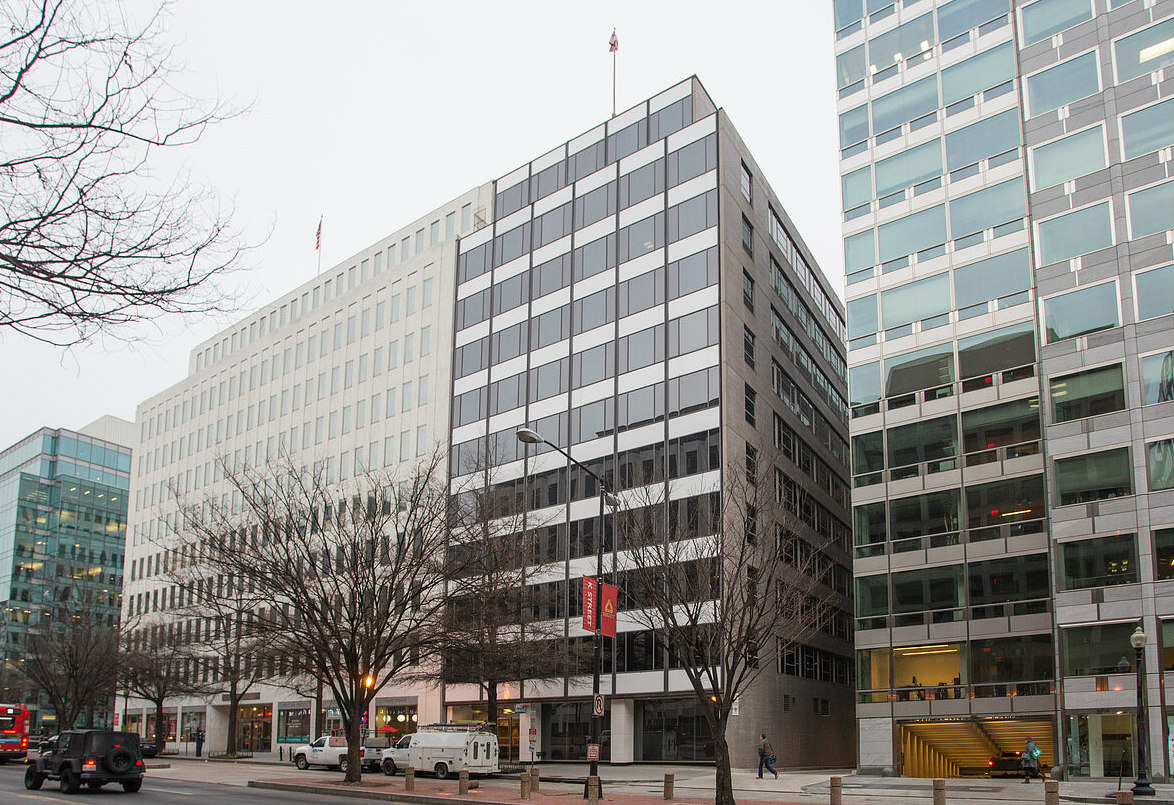
In 1983, NASD was actively modernizing securities trading. It had just launched the National Market
System the year before, which allowed near real-time updates of securities prices. This was
also the era when NASDAQ was gaining prestige as a computerized marketplace, distinguishing itself
from traditional exchanges. And part of their modernization was switching from traditional IBM
mainframes to the more reliable Tandem NonStop, which is where I came in. At this point, I was
considered a Tandem expert in a field where that was a rare commodity.
I brought with me my copy of TUGLIB, the Tandem User Group Library, a collection of tools, programs and
callable routines for the Tandem, much of which had been written by me.
In this context, a "tool" might be a simple bit of code that converts a human-readable
date into a form the computer can understand.
When I was working at ACI, I had created TSCRIPT, a
simplified version of IBM SCRIPT, a procedural markup language used for document formatting.
Both SCRIPT and TSCRIPT used inline commands called control words (beginning with a period in
the first column) to specify formatting such as spacing, justification, and fonts, making both
powerful tools for preparing technical documents and large reports. By the 1980s, SCRIPT/VS was
widely employed in enterprise environments; and, since NASD was switching from an IBM mainframe
to the Tandem, that made TSCRIPT, which I had made control word-compatible, an exciting tool
to make available to my coworkers.
NASD had a dress code, I suppose, but I'm not sure it was ever written down. When I started there,
the programmers wore the usual: white or pale shirt, tie, slacks, leather shoes.
I decided to make it my job to destroy the dress code.
After all, we never saw "customers" or the public in any way. So who were we trying to impress?
I admit, I'd gotten spoiled at ACI where we could wear anything. If it was legal on the street,
it was acceptable there. But that was in Omaha, and I was now on the East Coast, where things
have always been more formal.
So I did it slowly. I started out wearing the uniform. But each day I loosened my tie just a little more.
By the third week, when I stopped wearing it entirely, I actually looked better.
But then I went back to the tie, and swapped the slacks for new jeans. Once everyone got used
to that, I started loosening the tie again. By the time I was done, I was wearing jeans and
Hawaiian shirts (which became my uniform for the next twenty years) and so was everyone else!
I was very proud of destroying a dress code.
But I did manage to "bring the NonStop down".
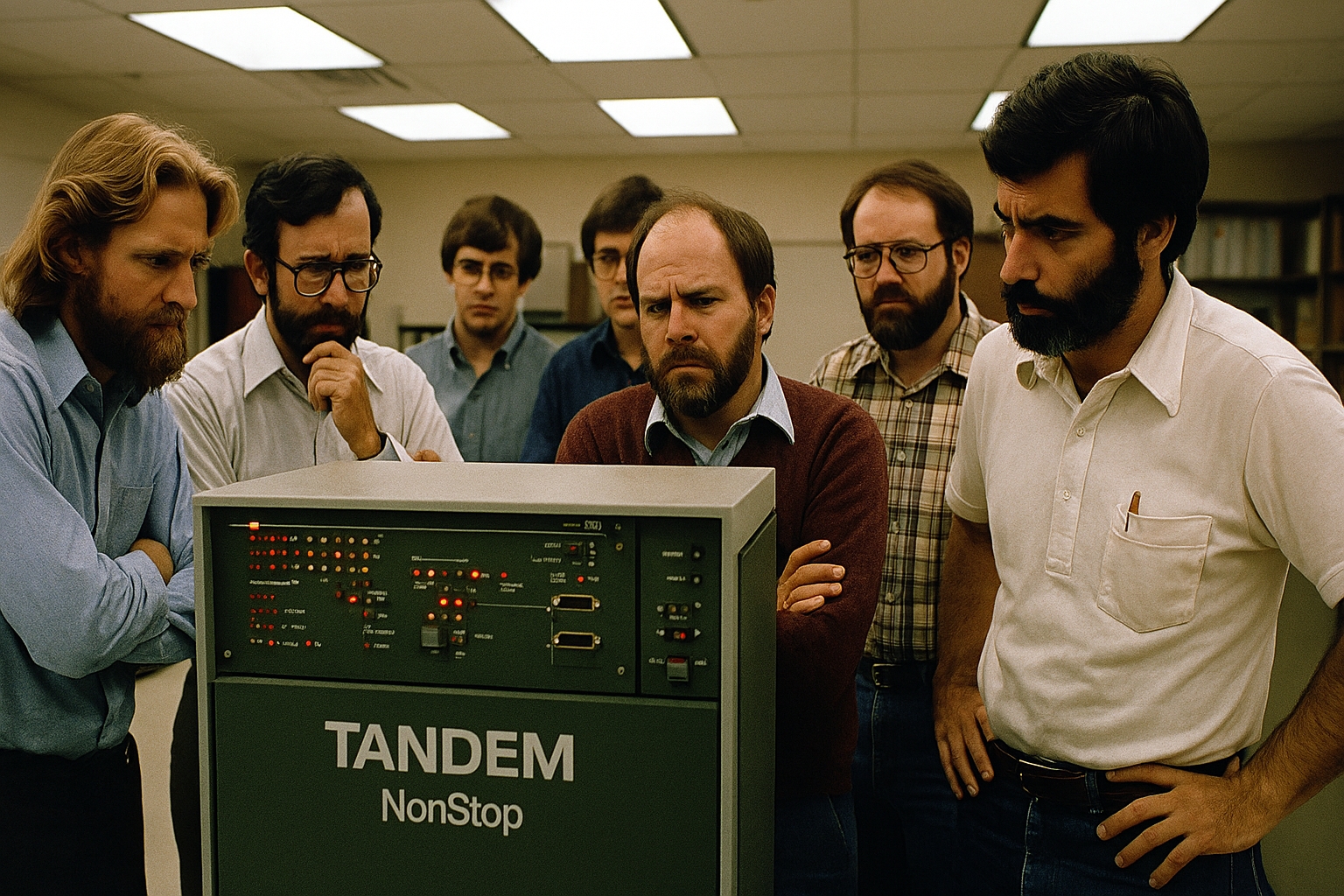
The thing to remember is that the Tandems were new, and the NonStop feature was simply the fact that
any program you ran, ran on two CPUs at once. If the primary CPU failed for any reason,
the secondary would take over and no one would know the difference unless they actually read
the system logs.
Unfortunately, this didn't matter if the program itself stopped the CPU, because then it would
do it on both CPUs. And that's what I, inadvertently, did. I shouldn't have been able to,
of course. But TAL, the language I wrote in, is 1) very low-level, compared to modern
languages; and 2) the compiler itself wasn't perfect—it wasn't uncommon for a procedure
to fail a test, then pass when a variable name was simply changed to something else.
So I was test running this program, and the moment I hit Enter to run it—the entire Tandem
NonStop system crashed! Hard, so hard it had to be rebooted. Of course, I didn't think I
had caused it. So, after about 20 minutes when the system had come back up, I tried running my
test again—
CRASH. Again. Of course, this time I doubted it was coincidence. I notified my boss,
and, when the system had again been restored, he asked me to try running it again.
He was more concerned that it was possible to bring the Tandem down, than he
was at having another outage. And, sure enough, when I pressed Enter on that Run command,
it happened again.
So my boss had to notify Tandem that their NonStop did, in fact, stop. And, meanwhile,
I made a small, random change to my code and recompiled, and, the problem was gone.
NASD's offices on K Street were full of terminals and paper reports. Most of the work was routine:
programs ran overnight, numbers came out in the morning, and the market trusted them.
It was a "cubicle farm," and the guy who sat across from me (so I could see into his cubicle)
was Chuck. About a decade older than me, he was a nice guy whose computer language was
COBOL. Chuck faced a daunting task: converting a legacy IBM COBOL program that calculated stock prices
using sales data, seasonal trends, and regional modifiers into a Tandem COBOL equivalent compatible
with the NonStop architecture. He rewrote PERFORM loops to align with Tandem's fault-tolerant execution
patterns, replaced file I/O calls with Guardian-compatible routines, and restructured the program
to handle real-time updates instead of overnight batch runs. Along the way, Chuck had to debug
decades-old logic written in cryptic conditionals and adapt it to Tandem's stricter data typing and
interprocess messaging—all while preserving the original business rules that determined how
sales fluctuations influenced stock valuations.
The original program calculated daily prices,
using the previous day's value, trades during the session, and volume. It had been
in place for years. Nobody questioned it.
But when Chuck compared the Tandem output to the IBM
results, the numbers didn't line up. At first, everyone assumed the rewrite was wrong. He checked
the logic line by line. The Tandem version was consistent. The COBOL version wasn't.
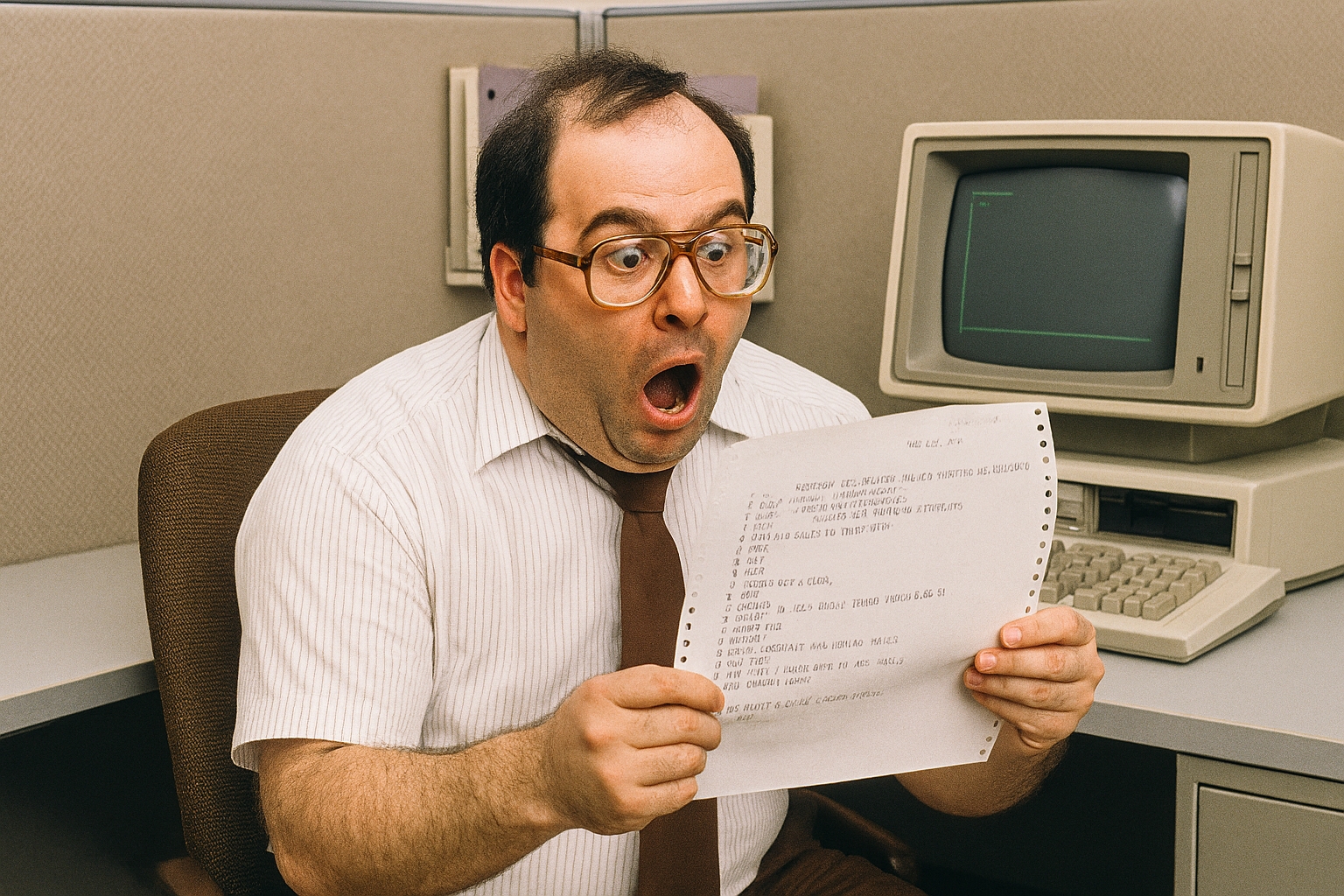
That was the shock: the IBM program had been wrong all along! Chuck's Tandem code was producing the correct values,
but those values were different enough that publishing them outright would have caused chaos.
In fact, the situation was so precarious that Chuck (and I, who was in earshot of all this) was
cautioned against mentioning it to anyone.
The solution, implemented in secret, was to merge the two. For a period of time,
NASD released numbers that were a weighted
blend of the old and new calculations. Each day, the balance shifted slightly toward the Tandem
output. Eventually, the correct values became the standard.
The market never noticed the transition.
But Chuck, his boss, and I knew what had happened. It was a reminder that even the most trusted systems
could be flawed, and that fixing them sometimes required more than just technical accuracy.
We had to protect the public, who thought computers were infallible, from finding out the truth.
Or maybe we were protecting ourselves.
In any case, life went on; NASD was replaced by the Financial Industry Regulatory Authority (FINRA) in 2007;
and people no longer believe computers are infallible. So I can reveal this little tidbit without
further breaking the stock market (which is still just a casino for rich idiots).

Then there was Tim. About my age, we became buddies outside of work as well as in. He even went camping
on a weekend with me and the family! One day he shared a secret with me. "Do you want to know how much
Chuck gets paid?" he asked, and proceeded to tell me even though I told him I didn't really care. Besides,
NASD, like most places in those days, had a specific rule against talking about our salaries with
each other. "Well, it's all in a file named SALARIES, and if you want to read it, no one is stopping
you. So they can't care all that much."
Well, it turned out they did care; management just didn't know how to encrypt or lock a file.
(To be honest, I don't know there was a way, on the Tandem, back then.) Nevertheless, they fired
Tim for his indiscretion.
Since I worked at NASD for a couple years, I commuted in every season. It was an easy commute on the
city's Metrorail system, which had stations at either end of the block on which NASD was located.
I've always tried to get to work a little early, but the building itself didn't open until, like,
8:30. So sometimes I would wait outside if I had arrived too early; and if it was winter, that
was a cold wait.
One bitterly cold winter morning I arrived early and decided I would make a quick stop at my bank, located just
across from the subway station. However, when I got there, it was also still closed. The doors wouldn't
open for another five minutes. And I wasn't the only person waiting; a homeless guy I recognized from
the area was also waiting. I realized he probably didn't have an account; he was just waiting to
sit in a warm room until they made him leave.
As I said, I had destroyed NASD's dress code. So I was standing with this homeless guy in my jeans
and Hawaiian shirt under a parka, which itself had seen better days. I smiled at the homeless
guy, and he gazed at me assessingly. He then handed me a quarter.
Which I took, because I didn't understand what was happening at first. Then I realized: He
had not only mistaken me for also being homeless—he thought I was worse off than him!
And before I could give him his quarter back, the bank open and we were separated as others also
entered.
After that, I bought new Hawaiian shirts.
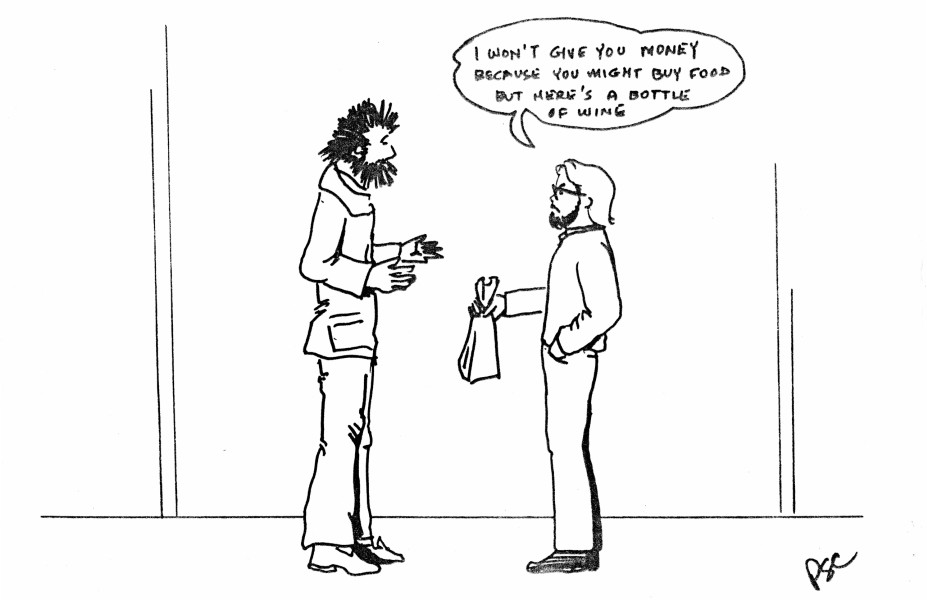
It did inspire me to draw a cartoon, though.